I know I've largely been posting about stuff from outside of Lima, but I've been hanging in the city for the past week. I've been busy with family lunches, and the march last Thursday.
Today we had lunch at Jacho's place. Carlita's mom came an brought us a bunch of rocotos rellenos -stuffed rocoto peppers, a specialty of the Arequipa region, where their family is from. Jacho, Diego and I had, for our part, gone to the market in Jesus Maria for ingredients so that Diego could make a turmeric-flavored rice with pork and beans that he invented and had been requested by Jose and Willy.
It turned into a great meal (the rocotos were nice and spicy) enjoyed in good company.
Later on I hitched a ride with Jacho and made my first trip so far to a bookstore, so it was a good day from start to end.

Sunday, July 15, 2012

Anti-repression, pro-environment march in Lima

On July 12th, there was a march in Lima demanding:
- That the Ollanta Humala administration keep its electoral promises
- End of repression against the mass movement in Cajamarca and Cuzco's Espinar province against mining concessions
- No to the Conga mining project in Cajamarca

The popular movement in Cajamarca against the concession of mining permits to Yanacocha corp. for the Conga mining project, which would drain a number of lakes and dry up several streams, in addition to leaving the area with a legacy of toxic waste, called for a nationwide support mobilization on the 12th, so the the Conga issue was merged with the march already called by the General Confederation of Peruvian Workers (CGTP). (Marches also took place in Ica, in Arequipa, and -in defiance of a declared state of emergency- in Cajamarca)

The concentration point was at the Plaza Dos de Mayo -right in front of the CGTP headquarters- and the march was to end at the Plaza San Martin, a traditional spot for large political rallies. In between it wound through downtown Lima, stretching 8-10 blocks across four lanes of road.
I had learned about the mobilization from a group of demonstrators in Trujillo, and determined to add my presence to the cause. I accompanied the march from Plaza Dos de Mayo, down Nicolas de Pierola, Wilson, and to the Plaza Grau. At that point we had marched quite a distance and it wasn't clear to me what the remainder of the route would be, so I called it a day and missed the final rally in Plaza San Martin.
I had learned about the mobilization from a group of demonstrators in Trujillo, and determined to add my presence to the cause. I accompanied the march from Plaza Dos de Mayo, down Nicolas de Pierola, Wilson, and to the Plaza Grau. At that point we had marched quite a distance and it wasn't clear to me what the remainder of the route would be, so I called it a day and missed the final rally in Plaza San Martin.
By the evening and the following day, the news media -largely pro-"development"- focused their coverage not on the march, the rally, or the demands, but on the graffitti painted on the pedestal of the monument to Gen. San Martin by a group of anarchist youth from the Union Socialista Libertaria. There were the usual demands that left "distance" itself from, and "condemn", "radicals" and "violent" sectors. The occasion was also used to try to put lefty mayor Susana Villaran on the spot for allegedly not policing the event sufficiently.
The only exception to this bandwagon that I saw among the daily press was La Primera newspaper's coverage.
Saturday, July 14, 2012
Chan Chan
Before visiting the Huaca de la Luna in the afternoon of the 7th, we made our first stop that morning in Chan Chan.
Chan Chan is a the remains of a mud-brick city built starting in the 9th Century by the Chimú people and served as the capital of the kingdom of Chimor. The city consisted of nine palace compounds, each built and occupied by a subsequent ruler or royal family. Each compound, in turn, was made up of a public ceremonial sector, a private religious sector, a residential sector for the royal family, storehouses, and a funerary building where the mummies of deceased rulers were housed.
As each ruler died his successor built a new compound for himself and his family and entourage. However, the previous rulers' compounds were not abandoned, but continued to serve as temples and ritual centers dedicated to the veneration of the deceased kings.
The complex of royal compounds was itself surrounded by fields and residential areas for the common people. Scholars estimate that Chan Chan and its surrounding areas may have housed 30,000 people, and perhaps as many as 50,000. The kingdom of Chimor lasted until about 1470, when the Incas dethroned the last Chimú king, Minchancaman.
The city covered some 20 km² (12 sq. mi.), with the dense core of palace compounds alone covering some 6 km². It was the largest mud-brick city ever built in the Americas.
I had been there 40 years ago, when I took a childhood trip to the region with my parents. Chan Chan, unlike the Huaca de la Luna, was pretty much as I remembered it.
Only part of Chan Chan has been
excavated -though much of it has been looted- and most of that work was
done in the 1970s. Since then, the bulk of research has been focused on
preserving the city, specially what has been excavated and
reconstructed, from the wear-and-tear of visitors, humidity, and
rainstorms brought by El Niño.
Although when I was a kid, because my dad knew the archaeologists involved, we got an extensive tour of Chan Chan, this time around
-like other visitors- our group was limited to touring the Nik An complex
(formerly called the Tschudi Complex), which is believed to have been
one of the last ones erected, and has been cleared, preserved, and reconstructed to a large degree.
 |
| 40-foot tall external wall of the palace |
 |
| Frieze depicting the sea and fishes swimming in an ocean currents |
 |
| One of two wells in the palace. |
 |
| Frieze depicting waves on the sea and what may be sea otters |
 |
| Internal esplanade |
 |
| An altar, surrounded by crosshatch pattern depicting fishing nets |
 |
| Palace entrance courtyard |
 |
| Religious portion of the palace compound |
 | |||||
| Unexcavated parts of Chan Chan |
Huaca de la Luna
Last Saturday - July 7th- I was fortunate to be invited along on a tour of the archaeological sites of Chan Chan and the Huacas de la Luna & del Sol organized by Susana's group/project leader, Douglas Sharon.
Doug is a really interesting fellow. He currently specializes in studying folk healing (curanderismo) and folk use of traditional herbal remedies, but previously he had been an archaeologist. As a teenager he ended up as a lead field team manager on the famed 1964 Savoy Expedition which disproved Hiram Bingham's contention that Machupicchu was the legendary Vilcabamba, the last stronghold of the Incas, and showed that Espíritu Pampa was the actual site of Manco Inca II's rebel capital.
Since then he has returned frequently to Peru and continued studying its traditions. As he told one of the students, "Peru gets ahold of you. You come to Peru, and if you come a second time, then you'll keep coming back."
After visiting Chan Chan (which I'll get to later) and having lunch in Trujillo, we made our way to the southeastern edge of the city to the Campiña de Moche, and to the Huacas de la Luna y del Sol archaeological site at the base of Cerro Blanco peak.
The two Huacas are the remains of large mud-brick pyramids constructed by the ancient Moche (a.k.a. Mochica). The site was a politico-religious complex that served as the capital of the Moche state from the first century B.C.E. until the 8th century C.E.
 |
| The Huaca del Sol |
The Huaca del Sol -which is currently closed to visitors- was constructed in stages, with different rulers expanding it in at least eight different stages. By the time work stopped on it, it consisted of an estimated 130 million adobe bricks contributed by as many as 100 communities, and even at its remaining height of 43 meters by 228 meter length and 138 meter width, it stands as the largest adobe structure ever constructed in America. It was named the Huaca del Sol because it was believed to have been a temple to the Sun, however archaeologists today believe that it may have served as a royal residence.
 |
| Huaca de la Luna, at the base of Cerro Blanco peak. |
The Huaca de la Luna is smaller but better preserved than the Huaca del Sol, which was severely damaged by Spanish looters. It was named Huaca de la Luna in the belief that it was the lunar counterpart to the presumed sun temple at the Huaca del Sol. It was a religious temple but to a pantheon of Moche deities.
I first -and last- visited the Huaca de la Luna in 1972 or 1973, when I was a child. The famed archaeologist and linguist Victor Antonio Rodriguez Suy Suy, who was of Moche ancestry on his mother's side (hence the Suy Suy matronymic), was a friend of my father's and he led us on a tour of the Huaca.
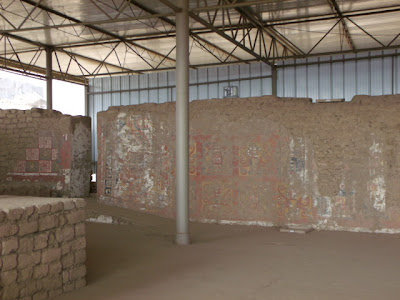 |
| The painted wall shown to me 40 years ago |
I remember it was bitingly cold and windy day, and that the sand, blown by the wind, stung my bare legs and arms. Suy Suy led us to a portion of wall protruding a couple of feet from the sand and dirt at the top of the mound that was the huaca back then and excitedly pointed out traces of blue and red paint. These newly uncovered traces were the first indication that the huaca, and perhaps many others, far from being earth-colored structures had in fact been brightly painted.

Today, archaelogists have uncoved a series of nested pyramids, each built atop -and entombing- the previous one, and each covered in murals.


Today, archaelogists have uncoved a series of nested pyramids, each built atop -and entombing- the previous one, and each covered in murals.


In fact, one external wall, many meters tall and wide, and facing what would once have been a courtyard or ceremonial plaza, vividly depicts the Moche social order, with prisoners to be sacrificed at the bottom and various deities at the top.

One extraordinary panel in the ceremonial plaza seems to depict the entire Moche cosmography and mythology.
Revisiting the Huaca de la Luna was a neat experience, and it was amazing to see the state of preservation of the murals, as well as the sheer visual impact that they have -specially the large courtyard wall- even faded and damaged as they are. One can easily imagine what it would have been like to see them in their brightly-hued prime, with music blaring and the incantations of Moche priests rebounding off the walls and the stones of Cerro Blanco.
 |
| Ai Apaec, the Decapitator God |
Wednesday, July 11, 2012
Views of Downtown Trujillo
 |
| Plaza de Armas |
 |
| Plaza de Armas |
 |
| House of the Mayorazgo de Facala (1709) |
 |
| House of the Mayorazgo de Facala (1709) |
 |
| Orbegoso house (mid.1600s) |
 |
| Merengues for sale |


Tuesday, July 10, 2012
Huanchaco

I spent last weekend -my second in Peru- away fro Lima again, this time up north, visiting Susana who is living in the seaside town of Huanchaco and working in nearby Trujillo during her summer break from school.
Huanchaco is a quiet little town at this time of year, when many of the businesses are closed for the winter. It was once principally a fishermen's town and a port for the loading of sugar cargoes from the hacienda owned by the Larco family - the former loading pier has been turned into a pedestrian walkway with a gazebo at its end. Today, it seems mainly to subsist on tourism, as the weather is mild all year round, it has a very pleasant beach, and is part of Peru's surfing and backpacker circuits.
 |
| Fisherman using a caballito de totora |
Huanchaco is also rekown for the locals' building and use of caballitos de totora (lit. "little totora horses"), reed boats that have been in use for centuries. In fact, depictions of caballitos have been found in 1,500-year old Moche pottery.
 The totora plant grows in wetlands and standing water, which is possible to achieve even in northern Peru's coastal desert plain because in the area of Huancacho the water table is only a few meters below the surface of the ground. The ancient Moche dug pits where they grew the totora, and many of these are still in use today, maintained -often by the same family- over many centuries. Though the totora plant is crucial to family substistence for many of the locals, the totorales are increasingly threatened by urbanization.
The caballitos themselves are handmade by local craftsmen and fishermen, who gather the totora stalks, dry them, and tie them into bundles. Each one has his own style and preference of materials, which -in addition to its placement- allows each fisherman to easily recognize his own boat.

On the beach front, near the pier, is a place called Jungle Bar Bily, which has a sort of jungle/tiki bar ambiance. It is open late and draws the more bohemian -and hard-drinking crowd- in the late hours of the night. They do serve a mean caipirinha.
One that has turned into a favourite of Susana and her companions is a small place a few blocks from the town's Plaza de Armas, called My Friend. At My Friend there is offered a selection of several dozen spaghetti dishes -on the menu it's labeled a "Spaghetti Festival", which has become a catch phrase for Susa and her friends- for a very reasonable s/. 10, and on Thursday nights drinks are only s/. 3 each. We ended up there almost every night of my visit, as we found ourselves feeling "festive".
There is also, of course, no lack of seafood choices of varying price and quality, in terms of both flavour and ambiance. (The three examples below are from a restaurant called El Mochica.)


I arrived in Huanchaco on Thursday evenning and stayed until Sunday night. In the intervening days, besides enjoying Huanchaco, I was able to meet Susana in Trujillo and tour that city for an afternoon, take a tour of the nearby archaeological sites of Chan Chan and the Huaca de la Luna, and take part in a cleansing ceremony by a local curandera, or traditinonal healer. I'll write about those experiences in future installments.

Subscribe to:
Posts (Atom)