Showing posts with label Festivals. Show all posts

Wednesday, July 22, 2015

Craft Beer Stand at the Lima Book Fair

I had a hard time at the book fair, I must say.

The fair is set up under a tent erected over the central part of park, covering a fountain and a number of steps.  The floor is thus of plywood sheets over a frame, and covered with carpeting, all of which makes in a bit uneven in many spots.  With my aching and sensitive knee, it made walking difficult, and even a bit perilous.   It was also very hot under the tent, and my off-gait was causing me to expend extra effort as it was.


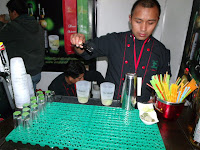
Fortunately, there is a craft beer stand in the food court, set up and run by a small distributor representing four small breweries - three from Lima and one from Cusco.


I chose two beers to try.

First, I opted for the Ayrampo Roja from the Sacred Valley Brewery, whose beers I had never tried before.


The Ayrampo Roja (6% ABV, 35 IBU) is a red beer (hence the roja) coloured with caramel malt and the fruit of the ayrampo cactus, which is native to the Peruvian Andes and has long been used to color foods in the highlands.  The beer was good, and there was no ayrampo flavour (it can taste a bit like red beets).

Next, I went for one from the Cumbres brewery.  I have tried one other of Cumbres' beers, their Quinoa Kolsch, so I was anxioux to try another of their offerings.


I opted for the Maracumanto (6.2 % ABV).   Maracumanto is a Belgian Pale Ale, fermented with maracuuyá and aguaymanto  fruit.   I half expected it to be sour, owing to the presence of the maracuyá, but it was not sour at all.  It was actually very refreshing, and relatively low in fruit notes in the mouth, even though they came through in the nose.

Needless to say, I then felt quite refreshed!

Lima Book Fair

I hurt my knee last week so I've not done much.    It was just yesterday that I've started to go out to places other than relatives' homes, and my cousin's medical practice.

My big adventure for the day was to get dropped off at the Lima International Book Fair after lunch at Toti and Marina's.

Normally, I hit the book fair a couple of times and can easily spend a couple of hours there on each visit.  This time, however, owing to my knee issues, I zipped through only stopping at a handful of stands, most of which I had already decided on visiting anyway.  In fact, I only delved in depth into two of them --those of the Istituto de Estudios Peruanos and of the Instituto Frances de Estudios Andinos-- and I only bought books at IEP's.


Thursday, January 29, 2015


Recently I was made aware of a Kickstarter campaign to fund the production of a documentary film by another traveller to Peru: Carlo Rojas, a young Peruvian-American, who's returning to his late grandmother's hometown --Huaylas, in Ancash, close to Huaraz-- to get into the culture and explore and document the town's main festival. 

It looks interesting, and I urge you to take a look at it as well:   

Monday, August 5, 2013

Lima Book Fair


On the Saturday after my birthday party and just before I returned to the US, I made it to the Lima Book Fair, which this year was in its 18th installment.

When Jacho and I arrived there was a big line to get in.  We were impressed that so many people, specially young people, were so eager to get in, particularly given that it was only the second day of the fair and there was yet another fortnight in which to visit it.  It turned out, however, that there was talk being given by Peruvian rock singer Pedro Suarez Vertiz at the presentation of his book, Yo, Pedro, which occasioned the long lines outside and, again, inside the tent!

Unlike other times, when I would scour the fair from end to end, and return on multiple occasions, this time around -due to matters of space and luggage weight- I went only the one time and targeted my shopping toward a few key stands and a predetermined wish-list of books I had been holding off on buying until the fair. 

Among them:
  • Memorias de un soldado desconocido by Lurgio Gavilan
  • Historia de la corrupcion en el Peru by Alfonzo Quiroz
  • Los Quipucamayos by Frank Salomon

I was also pleased to be able to pick up a copy of Sombras del Imperio: La nobleza indigena del Cuzco, 1750-1825, a translation of Shadows of Empire: The Indian Nobility of Cusco, 1750-1825, a book by Reed College professor David T. Garrett, whom I had heard speak on the subject at a talk at the Alianza Francesa a few weeks earlier.

Monday, July 9, 2012

Iquitos street food


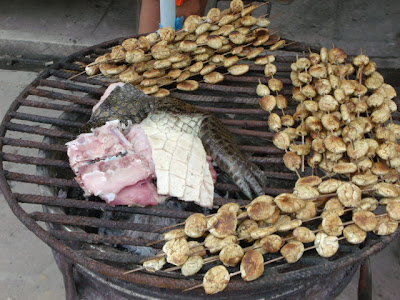
The weekend we were in Iquitos -the last weekend in June- was a 3-day weekend honor of the feasts of St. Peter and St. John.  St. Peter being the patron of fishermen, there was a parade in the port district of Nanay and its streets were crowded with makeshift kitchens and eateries selling the local fare -mostly grilled chicken and fish, regional specialties such as tacacho (roasted green plantains, pounded to mush and formed into a ball), cecina (salted and smoked pork or peccary meat), and juanes (turmeric-laced rice, with chicken or pork, cooked in banana or bijao leaves), as well as some less pedestrian items such as turtle and cayman.

Cayman meat, with a type of roasted seeds
Bottom: Roasted plantains; Right: Tacacho, with bits of cecina

Another favorite snack in the region -and one much missed by at least one iquiteno cab driver in Lima- is suri.


Suri are the grubs of a beetle, Rhynchophorus palmarum, which lays its eggs inside palm trunks. There, the larvae burrow, feed, and grow fat for 50 to 70 days before pupating.  In parts of Latin America that rely on the production of palm oil or coconut products for a living, the grubs are considered a pest.  In Peru's jungle communities, however, they are a treat.

I had mine roasted.


Upon biting into a suri one is immediately struck by the fattiness of the grubs.  It is not surprising that they came to be viewed as a treat in a land where, for millenia, people have had to take advantage of every precious source of calories they could get their hands on.

The taste was somewhat reminiscent of the fatty trimmings off of a cooked pork roast.   To be fair, I expect most people are turned off by the fatty, oily mouth feel before they even get to the flavour.  It was not an altogether unpleasant flavour, but I won't claim to have liked it.

After eating the guts and juices, I was left with the tough skin.  It was a bit like chewing on a plastic bag.  I just spat it out.

Sunday, March 18, 2012

Video: "Lima and the Sea"


This video was prepared by El Comercio for showing during the 7 Mares ("Seven Seas") festival held in Lima on March 17.   The video honors the Peruvian sea as the source which allowed Lima's ancient cultures to develop, and is part of El Comercio's campaign to build awareness and pride in Lima's ancient past and for preserving it's historic monuments.

Saturday, January 21, 2012

Chinese New Year in Lima

On the eve of Chinese New Year, I thought I'd share these photos taken by Liz in Lima's Chinatown during the Chinese New Year holidays in 2008.


Tuesday, July 26, 2011

Pisco Day

Sunday was National Pisco Day and at the Circuito de Aguas there was a pisco and marinera festival, so we headed there to enjoy the fountains and have some pisco along the way.

The city had shut down the large, record-setting fountain in the park and in the esplanade around it there had been set up a number of booths run by various pisco producers.    We got to try some pisco sours and classic chilcanos, but the stars were some chilcanos at the Sol de Ica booth prepared with pisco infused with fruits, vegetables, and herbs.   We tried a blackberry or mulberry chilcano that we weren't that impressed with, but we had our horizons expanded by a chilcano made with sweet basil leaves and cucumber slices, and a spicy one made with aji-infused and ginger-infused piscos.


In addition, we got to watch part of the game between the Peruvian and Spanish national sub-20 teams being played at the National Stadium next door, as it was broadcast on a giant screen at the water park.

Tuesday, July 19, 2011

Devils on the rooftops

In Paucartambo -and in other Cusco towns- during the feast days of the Virgen del Carmen, in mid-July, dance troupes associated to specific religious fraternities take to the streets and, through their dances, essentially act out religious plays.     One set of important characters in these are the saq'ras, or devils, who haunt the streets surrounding the church -being unable to enter it- and on the last day of the festival, when the effigy Virgin is carried in procession through the streets, the saq'ras are reduced to haunting the rooftoops and treetops, emiting their trilling cries, and waving their canes at the Virgin and her worshippers.

In Cusco, on the afternoon of the 7th, as part of the celebrations of the 100th anniversary of the "discovery" of Machupiqchu, Cusquenos made an effort to bring out elements of their folklore.  Accordingly, we found a troupe of saq'ras haunting the Plaza Espinar and the Basilica de la Merced.

As Liz said at the time, we were pretty lucky to have chosen those days to be in Cusco!


Friday, July 30, 2010

Book Fair finds

Yesterday, after lunch I made time to head to the 15th Lima International Book Fair which is being held at a park near San Felipe, Parque de los Proceres -which everyone still calls Matamula, even though it's name was officially changed in the early 1970s.

Aside from a book on early photography in Ayacucho and one on the events in Bagua last June, I was rather pleased to find some older books which can be rather hard to find in Spanish, including a translation of Capital that was previously unknown to me.


Particularly pleasing was the opportunity to pick up a copy of the bookbound edition of Rafo León's Caín y Abel.


Caín y Abel  originally appeared as a series of vignettes in the monthly No! supplement to Lima's magazine in 1987.  The storyline was told from the viewpoints of two twin brothers, Caín and Abel. 
 

Caín was a rebel, part of Lima's "underground" (subterraneo or subte) music scene, and something of a black sheep. His contributions were punctuated with swear words and lyrics.   Abel, on the other hand, was a sweet, studious boy, who wanted nothing more than to please his mother, and who's sanctimoniousness drove Caín crazy and made his father worry for his sexual orientation.   The humor lay in the disparate ways that each described the very same events and the way that León was able to so fully convey each of his character's idyosincratic world-views.

Tuesday, February 2, 2010

La Candelaria

My brother's being in Puno right now for the festival of the Candelaria has gotten me thinking back to 1988, when Liz and I had the fortune of being able to attend the festival. (These photos are from then.)

The yearly festival celebrates the Virgin of Candelaria, or Mama Candelaria, the patroness of the city of Puno, which is located on the shores of Lake Titicaca, in southern Peru, at an altitude of 12,420 feet above sea-level.


A supay

Characteristic of the festival and a recurrent motif in the folklore traditions of the Altiplano -the high plateau which spans the southern Peruvian and northern Bolivian Andes- are the supays or devils.   These extravagantly-costumed dancers -which are also a main feature of Carnival in Oruro, Bolivia- are said to have originally represented the visions seen by the Altiplano's miners under the effects of coca, hunger, and poisoning from the mercury used to extract the silver from the ore of Potosí.  Today teams of supays dance in the streets, in a diablada (devil dance).   The diabladas are joined by other types of costumed dance crews dressed as shepherds, bears, black men, Spanish overseers, angels, and the sicuris, who dance and play drums and pipes.


A "bear"

A "Spaniard"

The festival itself involves the crews dancing through the streets to the sounds of drums and zampoñas (pan pipes), and culminates, if I recall correctly after 22 years, with the arrival of the litter bearing the effigy of the Virgin at the church at Parque Pino in downtown Puno. 

A diablada
Virgen de la Candelaria

Even it is the third largest folkloric festival in South America, after Carnivals of Rio and Oruro, it is not much known about in northern latitudes, and remains a hidden gem amongst so many that Peru has to offer.

Certainly Liz and I knew next to nothing about it until we decided to go to Puno, while we were living in Peru for six months, during a break from our studies, and we simply picked the date because there would be "something" going on in town then.   It was, needless to say, an something neither of us has forgotten.

A supay

It is quite an experience, with the whole town thrumming with the vibrations from the drums, while fireworks go off at unexpected moments. The inescapable noise draws you in and makes you a part of the event, whether you want to be or not, while the nightmare figures whirling everywhere one looks add a surrealistic, dreamlike quality to it all, which is heightened by the drumbeats and, for visitors, by the lower oxygen level at that altitude.

 One particularly odd moment was when, while walking the streets one afternoon, I saw an elephant shoot across an intersection.   It was such an unexpectedly weird thing to see anywhere, let alone high up in the Andes, that I stopped in my tracks.  No one else seemed to have noticed, so I was seriously starting to doubt my senses and wonder if perhaps I were not hallucinating from oxygen deprivation even though I felt fine.  It wasn't until the rest of the elephants caught up a minute or two later, advertising the fact that a circus had just gotten into town for the festival, that I was able to regain my composure!

Thursday, October 15, 2009

Turrón de Doña Pepa


October, in Lima, is devoted to the Señor de los Milagros - the Lord of Miracles.     The Señor de los Milagros is a painting of Jesus on the cross painted by Angolan slaves on a wall that was later the only one to survive the devastating quake of 1655.   The image was later credited with doing away with a caretaker's tumor, and with having resisted efforts by the Church hierarchy to have it painted over -several hired painters were physically unable to carry out their orders.

Since then, has been viewed as being imbued with the Holy Spirit and in 1715 the depiction of Christ was declared the patron and protector of Lima and christened the "The Lord of Miracles."   In October1867, and every October since, a reproduction of the painting -which itself now resides in the Las Nazarenas church- was taken out in a several day-long processional through downtown Lima.   In honor of the Señor de los Milagros people and institutions drape themselves in purple cloth, giving October the nickname of the "Purple Month."

October has traditionally also been given over to the confection and consumption of special sweets and foods prepared specially for that time of year.   The most traditional and perennial favorite among these is turrón de Doña Pepa.    There are numerous versions of turrones throughout the Americas and Europe, some are nougaty others chocolate-based.    Lima's Turrón de Doña Pepa is composed of several layers of lightly anis flavored shortbread sticks held together with syrup made from raw sugar and spices, and garnished with candies.   Older, more traditional varieties also include candied fruits in the toppings.   No one knows with certainty who Doña Pepa was or why her name is associated with the pastry.

It used to be that one had to wait until October to sample Turrón de Doña Pepa, but in the 1980s it started to be available all year round.    The place where we knew to get it was at a shop called Aurelia in Lince.   Whenever we travelled to Lima, our grandmother would send us back to the States with a kilo or so of Aurelia turrón.    In the 1990s, sadly, Aurelia closed after the partnership split up, but today turrón can be found in all of Lima's major grocery stores, though it is usually substandard.   A better option is to seek out one of the shops set up by the major and reputable manufacturers of the stuff, like San Jose.   If you do, be sure to sample a variety, from the oldest types, with candied figs, to the newer ones flavored with orange rind and other fruits.

Just thinking about it makes me wish I were there.

Thursday, July 30, 2009

Bullfighting


On the 28th itself, Independence Day, we headed off to the nearby village of Muyurina for lunch and to watch a corrida bufa, a bullfight in which the bullfighters dress in comic outfits and put on a degree of slapstick in the ring.

One of the characters that always is portrayed is that of the Negra Tomasa. For this the bullfighter dons blackface and an Aunt Jemima-like outfit of dress and head scarf or cap. Usually the outfit includes large breasts and buttocks made with balloons. The character doesn't particularly act "black" but is usually sassy and plays up the "attributes" when facing the bull.

For some reason, the accompanying characters always seem to be drawn from the popular Mexican TV comedy El Chavo del Ocho, with the characters of Chavo, Quico, and Chilindrina being the usual ones portrayed. In this instance, we got Chilindrina, although they brought along Chavo's barrell.

The bulls -actually five bullocks and one cow- had supposedly been brought from Rasuwillca, but seemed like they had been simply pulled in from the fields. They lacked the aggressiveness of true toros de lidia, which was, of course a good thing and expected. However, the makeshift bullring proved unable to keep in the animals, a good number of whom managed to force their way out and back to the herd.

There was, nontheless, some excitement in the ring that afternoon, with the band adding the necessary taurine ambience to the event.

The highlight for us came late in the afternoon when we managed to cajole Nicolas into jumping into the action, much to Susana's distress:


Saturday, February 16, 2008

Ayacucho, Carnaval 2008

Here are two short videos taken by Diego of Liz and Co. dancing in the streets and plaza of Ayacucho during Carnaval. If you keep your eyes open you'll also be able to spot Danny and Juan Ramon in the comparsa. They did this for three days and on into the nights, and though it rained often, "it didn't dampen any spirits, just our clothes." The semi-official estimate is that 150 such groups took part in this year's Carnaval festivities.


Sunday, February 3, 2008

From Liz

Having just arrived in Lima, Liz is given the traditional welcome at Mi Carcochita, in Lince.
Those are my cousins Diego, on the left, and Juan Ramon.


"We´re in Ayacucho, having arrived on a flight that got us here at 6am.

"As it is Sunday, the town was still sleepy and it took us about an hour and four stops to get a cup of coffee and chaplas con huevo. Cafés either weren´t open or they didn´t have bread or they didn´t have coffee or the water wasn´t hot yet...finally our success came the second time we stopped at a stall in the mercado.

"After that Danny and I did a little shopping...trying to find boxer shorts and T shirts that fit him [his luggage did not arrive in Lima with him] was a true treasure hunt, but we had a bit of success. At least he now has clean calzones, two shirts and a tooth brush. We both got some music and I purchased some fresh wawa from Betty's tia. Yummm...

"Siestas for everyone after that...

"Here I am now. Having a great time, but still thinking of you all. Yesterday was El Dia del Pisco and we celebrated like true peruvians, drinking all types of Pisco drinks at the festival in the park in Surco. We collected a whole bag of cups from the different distilleries, and Danny and I made a purchase or two.


"Poor Toya and Willy..we stopped off to have cuyes afterward, but as we were all thoroughly wasted, I don´t think we were good for business, as we had the table right up front. There was talk of karaoke or dancing, but we all went back to the resi and to bed, having to get up at 2:45 to leave for the airport. Ughh.

"The plane had 20 seats...very small, but we were all so tired, we slept (with the addition of some rhythmic snoring from Juan Ramon). I woke up about a half an hour later to a beautiful sunrise over the Andes."


Saturday, February 2, 2008

Liz is in Peru

Yep, Liz is in Lima to enjoy some sun and leisure for a bit. Tomorrow she journeys to Ayacucho for Carnaval.

As a preview of what awaits her, I offer this video by Ayacucho singer Kiko Revatta, featuring some of typical street dancing in traditional dress (It also has some good views of the historic downtown streets):