Showing posts with label Art. Show all posts

Thursday, July 13, 2023

Art in Callao

Last Friday we took a trip to Callao, Lima's port city, where a portion of its old downtown has been being cleaned up and restored bit by bit.  One of the features is an old building, which I am told, was at one time the central post office.  It has an grand hall which crosses from one side of the block to the other, with marble floors and busts of philosophers and artists lining the walls. Above, a beautifully-preserved stained glass ceiling allows in plenty of soft natural light.

The numerous side rooms on the first floor have been turned into spaces for artists to display their work, most of it with an ironic sense of humour or touching on social themes and issues such as environmental degradation, youth culture (basically, hip hop), and so on.


Sunday, July 16, 2017

Lamp of the Three Graces


In downtown Lima, the Lamp of the Three Graces has stood at at the intersection of Ave. Nicolás de Piérola (also known by it's older name, La Colmena) and the Jiron de la Unión, where Nicolás de Piérola meets the Plaza San Martin, since 1915. Three Graces in fact predates the plaza itself, which was inaugurated in 1921, for the centennial of Peru's independence.

The lamp consists of a bronze sculpture of three women standing back-to-back around a central post which bears two rings of light globes.   It is an approximate copy of a famous marble sculpture, now in the Louvre, by 16th Century French sculptor Germain Pilon.  However, instead of supporting an urn for the heart of King Henri II of France, it holds a light fixture.

According to research by the author of Lima La Unica blog, the lamp was cast by the Val d´Osne foundry, which was located in Osne-le-Val, France. The Fonderie Val d'Osne became one of France's most important "art cast iron" foundries.

The Three Graces originally were located in the patio of the Principal Theatre. In 1889 it was moved to the Plazuela de la Merced, where it stood until it was moved to its present location.


Friday, July 18, 2014

A Few Photos From Along Ayacucho's Main Plaza

The Plaza


Ayacucho's main plaza


Equestrian statue of Gen. Antonio Jose de Sucre, one of Bolivar's lieutenants, who led the Independentist forces to victory over the last remnant of the Spanish colonial army at the Battle of Ayacucho.


Most of the plaza was built in the late 1500s and 1600s and all the buildings are in the Spanish style of the time.  There is one detail, however, that passes unnoticed even by people who've grown up in Ayacucho:

Portion of a wall  in Portal Independencia, along the north side of the plaza, showing that at least one Inca mason was used in erecting the original building along the plaza.  Note the close, mortarless fit between stones, and that the face of the each stone bulges out, and recedes toward the joining edges.


The Cathedral 


Ayacucho cathedral, erected in the 1600s and consecrated in 1671.  To it's right is the Zamora y Castilla mansion, which once belonged to Bishop Cristobal de Castilla y Zamora, who donated it to the newly-created University of Huamanga in 1677.


Central nave and the Baroque main altar of the Cathedral.

 Baroque wooden pulpit.

Detail of one of the chapels along the side naves of the cathedral.  In this case, the depiction is of the Holy Trinity.

The main altar.

Litter bearing the image of Our Lady of Mt Carmel, ready to be borne in procession in the upcoming Fiesta de la Virgen del Carmen (July 16th).

The University House


Patio of the Zamora y Castilla mansion.   According to some authorities, that fig tree is 500 years old and is the first one to have been brought to Peru.


Saturday, July 12, 2014

Ayacucho Museum to the Memory of Those Killed and Disappeared During the War Years

The main reason I traveled to Ayacucho last week was to attend a two-evening colloquium on "Class, Gender and the Building of Peace in Peru (1961-2014)".  It's main purpose was to examine the role of women in social movements, guerrilla groups, and in building peace and reconciliation, beginning with the  guerrillas of the 1960s,  but centering on the internal war waged  between the Peruvian state and the guerrillas of the Shining Path and Tupac Amaru Revolutionary Movement in the 1980s and 1990s.

Given the political climate in the country at the moment, all doors were closed to the holding such an event in Lima.  However, in Ayacucho, which had been at the center of the violence and which suffered the greatest number of victims -between those killed, disappeared, tortured, traumatized, and displaced- the doors were opened.  And they were opened by no less than the mothers and relatives of the disappeared organized in the Association of Relatives of the Kidnapped, Detained, and Disappeared of Peru (ANFASEP).


ANFASEP was started in 1983, when Angélica Mendoza de Ascarza -"Mamá Angélica"- after fruitlessly searching for her son Arquímedes, who had been taken one night by the army, joined with other women searching for their own relatives who had also been detained.  Mamá Angélica organized them to help each other draw attention to their cause and try to bring pressure on the authorities to release their relatives -or their corpses- and to bring those responsible to justice.  Now, thirty years later, they're still waiting for justice, and the fate and location of many of the victims, including Mamá Angélica's Arquímedes, are yet to be revealed.

Anyway, after thirty years of facing down authorities, threats, and every obstacle thrown in their path, the mothers of ANFASEP are not afraid of much, and they generously co-sponsored the event and got the Jesuit Order to provide the meeting space.

Not only did Adelina Garcia, ANFASEP's current president, open the event on Wednesday evening, but as part of it, they invited those attending to visit the ANFASEP's Museum of Memory, which was the first museum in Peru dedicated to exploring the war and to the memory of the victims.
ANFASEP's building on Prolongacion La Libertad, Ayacucho.

The museum houses photos, documents, and artwork related to the war's victims and their relatives' search for justice and reparations, and clothing and other items that belonged to the disappeared.


ANFASEP's first banner and the cross with the inscription "Do Not Kill", which they bore in their early mobilizations.


Mrs. Lidia Flores -standing before a photo of her late husband, Felipe Huamán, and the shirt he was wearing when he was taken by the police in July of 1984- talks about about the night he was taken, the day, a month later, when she discovered and  then secretly recovered and reburied his corpse, and her continuing struggle to gain convictions of the policemen who murdered him.

To say that the museum is moving, and harrowing and inspiring at the same time, understates the impact  on one caused by the exhibits and the courage of the women -mainly- who established and run it and ANFASEP.


Artwork depicting the kitchen which ANFASEP ran to feed 200 war orphans in the 1990s.

Thursday, July 3, 2014

Antioquia

Continuing on our road trip up the Lurín valley from Cieneguilla, we headed into Huarochirí province and to the town of Espíritu Santo de Antioquía, more commonly known as just Antioquía.

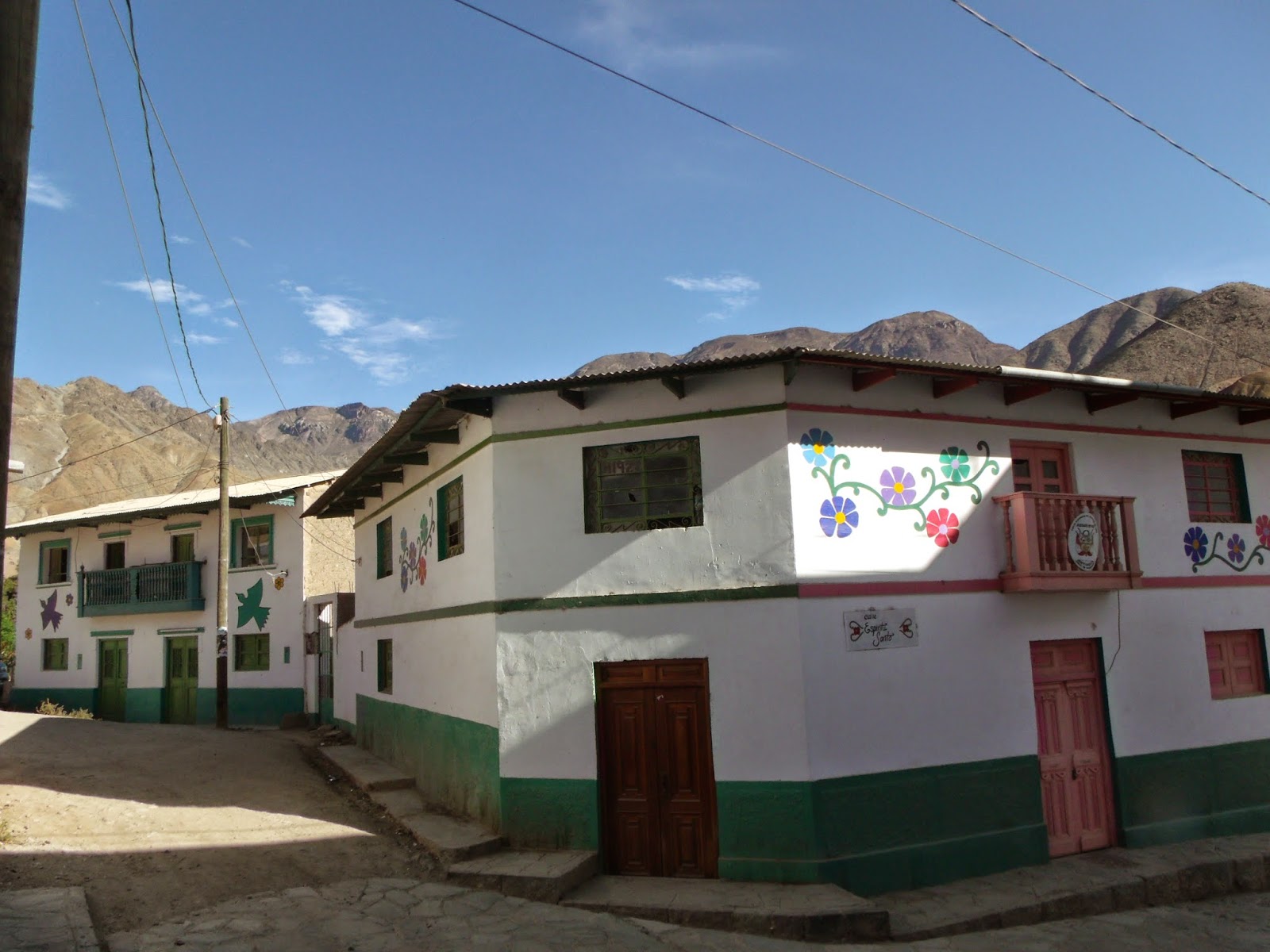
Antioquia's main square


Antioquia city hall
Antioquía's claim to fame is recent, and due to the townfolk's practice of decorating their homes with images drawn from nature - birds, plants, flowers.  The paintings, done in a naïf style, were the idea of a priest assigned to the town, who convinced the locals a few years ago to buy into the idea as a means of building town pride and pulling in a bit of the valley's tourist trade.  

Elba, Willy, and Liz in front of Antioquia's church

It must be admitted that the idea has on fact worked.  We, for example, were the third delegation from our family to make the trip to the town in the past several months, and we had all learned about it from it's being featured in newspaper, magazine, and television segments.


The road to Antioquía is still a bit rough, but even so there's enough traffic to allow a couple of restaurants with large seating to operate in town.   I expect that once the road is paved the whole way, it won't be long before a good segment of Cieneguilla's weekend tourist traffic will head that way, even though it is about an hour further, much as the summer beach exodus has moved ever further out of the city in the past decade.

u

Saturday, June 28, 2014

"Castillo de Huarmey" exhibit at the Lima Museum of Art

After lunch at the Sheraton Hotel with Juan Ramon, Liz and I walked to the Lima Museum of Art (MALI) where there was an exhibit of artifacts recovered from the ruins of a Wari-period palace at Huarmey, north of Lima.

The "Castle" was a stepped-pyramid shaped temple built some 1,200 years ago, and is the first unlooted tomb of nobility of the Wari culture that has been yet found by archaeologists.  It contained the remains of 63 individuals, of which 58 were females and included the bodies of three Wari queens or high-ranking noblewomen.  Over 1000 artifacts were also recovered - including the pieces depicted in the photos below.

The finds are significant because they have brought to light some previously unknown or unconfirmed facets of Wari life and cultural practices.  For example, they have allowed archaeologists and historians to glean a better view on the status of women in Wari culture. They have also confirmed that the Wari buried their notables with an assortment of grave goods, including perhaps human sacrifices, as well as the strengthening the theory that the Wari played a role in the decline of the Moche culture.
Wooden ear spools decorated with turquoise, sea shells, and other materials.

Gold ear spools.

Painted leather shoe.

(More on the discovery can be read here:  http://news.nationalgeographic.com/news/2013/06/130627-peru-archaeology-wari-south-america-human-sacrifice-royal-ancient-world)

Monday, June 23, 2014

Lord of the Fall


On the third block of Av. Republica Dominicana, just down from Plaza San Jose and across the street from the main market in Jesus Maria, resides a local landmark that is, literally, an icon.   

Inside a relatively nondescript archway that looks like it might be the entrance to the several-storey building above it, there is a figure of Jesus that is an object of veneration by locals and even people from further afield, including Mama Pali, my late grandmother.

The story goes that a sculptor named Marcos Huapaya created the image with the intention of selling it, but that fate intervened.    Huapaya had fashioned a previous religious image from wood, cardboard, and plaster, and wanted to create a larger one of Jesus.  He selected to depict a moment from The Passion in which Jesus stumbles under the burden of his cross.   The family thus decided to name the figure the Lord of La Caida (The Fall), a choice that was further cemented by their owning a country estate named La Caida.

Before Huapaya could sell the figure, however, a neighborhood woman gave him a white cord to add to the figure's vestments in thanks for divine aid she said she had received after praying before the statue.  Soon others started to do the same and Huapaya ended up building a sanctuary for it.

Later, when the family moved to Jesus Maria, they built the niche where the statue now resides, and where it receives numerous visitors daily, some of whom leave behind tokens of the "miracles" they say they have been granted after praying to the Señor de La Caida.

Huapaya has since died, but the niche is still maintained by his family, who open it up every morning and close it up every night.


Thursday, July 18, 2013

Lima Art Museum & José Sabogal exhibit

Yesterday afternoon I headed toward downtown, to the Lima Museum of Art (Museo de Arte de Lima, MALI).

The MALI is located at one end of the Parque de la Exposición, at the intersection of Paseo Colón and Ave. Garcilazo de la Vega (everybody still calls it Wilson, its former name), about a block down from the former US Embassy and the Casa Matusita.

The "Byzantine Pavillion".  In the background, at right, the "Moorish Pavillion".

The Parque de la Exposición was built for the 1872 Lima International Exposition, and the MALI occupies the main building, the former Palacio de la Exposición (Exposition Palace).

t
The former Palacio de la Exposición, today the MALI

Interior atrium of the Palacio de la Exposición
The building itself was restored in the late 1950s to house the museum, which opened its doors to the public in 1961.


Installation in the foyer of the MALI

The MALI houses examples of 3000 years worth of Peruvian and other artistic creations.  It also offers art classes and courses in art history, and has a library that is open to the public.

My purpose for going, however, was to view the current exhibit of works by Peruvian indigenist painter José Sabogal.


Part of the Sabogal exhibit

Sabogal was one of the first, if not the first, artist of note to directly and explicitly incorporate Andean and indigenous imagery and persons as central subjects in art.  


At L, "Varayoc de Chinchero" (1925); at R, "Mujer del varayoc" (1926).


Sabogal thus played a key role in Peruvian art and in Peruvian social history, at a time when the idea of Peruvian nationhood was being redefined as result of the disastrous war with Chile, immigration, and other pressures.   There was a search for an "essential Peruvianness", based less on geographical accident than on culture and history. 


That gave rise to a broad indigenista movement, which sought to bring to the fore Peru's indigenous culture.  In politics, it led to movements to promote civil rights and integration of Peru's Indian majority, and the exhaltation of Peru's Inca past.  In literature and art it led to investigation of traditional arts and legends, the exploration of native Andean themes.  (Pretty much the same thing was going in Mexico, for example, which gave birth to that country's famed muralist school of art.)


"El gamonal"

Sabogal made a study of traditional pyrography and etchings on dried gourds, an traditional craft that is practiced throughout the country, and published several articles on the subject, and was inspired by it in his own etchings and other designs.

He played a foundational role in the development of Peru's indigenistas.  For example -and this was a revelation to me- it was Sabogal who suggested the name of Amauta, the seminal political and literay magazine founded by José Carlos Mariátegui, and it was Sabogal who developed its logos and interior artwork, as well as a number of the cover designs. 


Issue of Amauta with cover by Sabogal, in my library

Sabogal influenced a generation of Peruvian painters who could be called the indigenista school. Camilo Blas (1903-1985), just to give one example.

Last year I attended the opening of a show of paintings and drawings by Camilo Blas , who was the grandfather of my friend Carla, and was a friend and disciple of Sabogal's.  Blas' work made an impression, and from the MALI showing the influence that Sabogal had on Blas's work was clear.  In fact, my initial interest in the Sabogal show was that I confused Sabogal's work with Blas' when reading an article in a magazine about the opening of the exhibit!


Portrait of José Sabogal

Thursday, July 11, 2013

Jiron Quilca

This afternoon I headed back downtown, again to Jiron Quilca.


Quilca is a street that stands out in several ways.   One that is not very obvious from the ground -although it could become evident with a bit of thought- is that it does not conform to the grid pattern of downtown Lima, but rather comes off of Plaza San Martin at an agle.

In the photo below, Jiron Quilca can be appreciated in the foreground, approaching the plaza at an angle rather at odds with the regularity of the surrounding streets.

Photo: skyscrapercity.com

When Francisco Pizarro traced the layout for dowtown Lima, he followed the "damero" (checkerboard) pattern of manzanas (city blocks) separated by streets criss-crossing at right angles.  This pattern is repeated throughout Spanish America and is the reason that the core of downtown is sometimes referred to as the Damero de Pizarro.   Quilca, however, notably breaks that pattern, appearing almost as a gash in the city in the image above.

The story is that Quilca follows the path of an Inca road into the city, and that at the triangular plaza at the what is today the intersection of Quilca and Av. Garcilazo de la Vega (aka Av. Wilson) there was once a tambo, or Inca way station.

Quilca is also noted as a center of Lima's bohemian life.   For one thing, the stretch immediately contiguous to Plaza San Martin is lined with dive restaurants that come alive with at nightfall and spend the days sleepily puttering along, smelling of stale beer.

Quilca is, more meritoriously, also home to the Queirolo tavern, which was established in 1920 by relatives of the Queirolo wine and pisco-making family that owns the Santiago Queirolo distillery and Antigua Taberna Queirolo in Pueblo Libre.


The Queirolo, with its unchanged decor, is counted as one of Lima's classic bars and old-school eateries, and it fills up at lunch and in the evenings.

Quilca is also a locus of a more modern, youthful bohemian crowd, which tends toward the metal and punk "underground" scene.  Much of which is centered -spiritually, if no longer physically- on the El Averno cultural center.


The center, which housed gigs and promoted the arts in general, was a vibrant presence in Lima's "alternative" scene for more than a decade, but also a constant object of police interest, who regarded it as a locus of "delinquency", and as attracting "bad elements" and "pot smokers" (OK, so maybe that last one was true! LOL).  But, maybe even more than that, it was the fear instilled in institutional and bureaucratic conservatism by what is new, free, and transgressive.

The center was raided it on a number of occasions, with the cops -and on two occasions, hired thugs- tearing the doors out of their frames, looting the place, and sometimes violently attacking the young people they found inside. 


El Averno shut its doors for perhaps the last time last October, after losing an appeal against a municipal eviction order, but its building remains, vibrantly and wonderfully defiant.

And even though El Averno is closed, Quilca's punk and metal scene has hardly faded away, as tucked away among the many used bookstores that line the street, there are small shops selling CDs, DVDs, fanzines, and anarchist newspapers, and which serve as clearinghouses -as do the very walls of Quilca's buildings- of information on concerts and new releases.