Showing posts with label Parks. Show all posts

Wednesday, July 2, 2014

The Cats of Parque Kennedy

A fixture in Miraflores' main park, Parque Kennedy (all of it is usually called that, even though only the westernmost portion of it is dedicated to John F. Kennedy - the rest of it is actually the Parque Central), besides the nightly antiques and craft market, traditional dessert vendors, and local characters, is the ubiquitous presence of numerous cats.


Some years ago people stared abandoning their unwanted cats in the park. Kindhearted souls in Miraflores started feeding the animals, and they multiplied. People, even in other districts, saw this and started viewing the park as a safe place to deposit unwanted kittens and to relocate captured strays.   Thus the park's feline population expanded.


 The Miraflores municipal administrationA group of neighbors (see comment below) meanwhile, started capturing the strays, giving them check-ups, immunizing them, and sterilizing them, before returning them to the park.   However, as more kept appearing, it has been made illegal to abandon house cats in the park.


Nonetheless, there seem to be more cats than ever, and they are everywhere -even in the trees- and are themselves one of the district's attractions for many people.

Thursday, July 18, 2013

Lima Art Museum & José Sabogal exhibit

Yesterday afternoon I headed toward downtown, to the Lima Museum of Art (Museo de Arte de Lima, MALI).

The MALI is located at one end of the Parque de la Exposición, at the intersection of Paseo Colón and Ave. Garcilazo de la Vega (everybody still calls it Wilson, its former name), about a block down from the former US Embassy and the Casa Matusita.

The "Byzantine Pavillion".  In the background, at right, the "Moorish Pavillion".

The Parque de la Exposición was built for the 1872 Lima International Exposition, and the MALI occupies the main building, the former Palacio de la Exposición (Exposition Palace).

t
The former Palacio de la Exposición, today the MALI

Interior atrium of the Palacio de la Exposición
The building itself was restored in the late 1950s to house the museum, which opened its doors to the public in 1961.


Installation in the foyer of the MALI

The MALI houses examples of 3000 years worth of Peruvian and other artistic creations.  It also offers art classes and courses in art history, and has a library that is open to the public.

My purpose for going, however, was to view the current exhibit of works by Peruvian indigenist painter José Sabogal.


Part of the Sabogal exhibit

Sabogal was one of the first, if not the first, artist of note to directly and explicitly incorporate Andean and indigenous imagery and persons as central subjects in art.  


At L, "Varayoc de Chinchero" (1925); at R, "Mujer del varayoc" (1926).


Sabogal thus played a key role in Peruvian art and in Peruvian social history, at a time when the idea of Peruvian nationhood was being redefined as result of the disastrous war with Chile, immigration, and other pressures.   There was a search for an "essential Peruvianness", based less on geographical accident than on culture and history. 


That gave rise to a broad indigenista movement, which sought to bring to the fore Peru's indigenous culture.  In politics, it led to movements to promote civil rights and integration of Peru's Indian majority, and the exhaltation of Peru's Inca past.  In literature and art it led to investigation of traditional arts and legends, the exploration of native Andean themes.  (Pretty much the same thing was going in Mexico, for example, which gave birth to that country's famed muralist school of art.)


"El gamonal"

Sabogal made a study of traditional pyrography and etchings on dried gourds, an traditional craft that is practiced throughout the country, and published several articles on the subject, and was inspired by it in his own etchings and other designs.

He played a foundational role in the development of Peru's indigenistas.  For example -and this was a revelation to me- it was Sabogal who suggested the name of Amauta, the seminal political and literay magazine founded by José Carlos Mariátegui, and it was Sabogal who developed its logos and interior artwork, as well as a number of the cover designs. 


Issue of Amauta with cover by Sabogal, in my library

Sabogal influenced a generation of Peruvian painters who could be called the indigenista school. Camilo Blas (1903-1985), just to give one example.

Last year I attended the opening of a show of paintings and drawings by Camilo Blas , who was the grandfather of my friend Carla, and was a friend and disciple of Sabogal's.  Blas' work made an impression, and from the MALI showing the influence that Sabogal had on Blas's work was clear.  In fact, my initial interest in the Sabogal show was that I confused Sabogal's work with Blas' when reading an article in a magazine about the opening of the exhibit!


Portrait of José Sabogal

Thursday, July 26, 2012

Salaverry and the Huatica

On my way today to the 17th Lima International Book Fair I walked up Avenida Salaverry toward the fair site at the Parque de los Proceres, built in commemoration of the forefathers of Independence.   The park, however, also bears an older name -Matamula- a leftover from the days when it was part of an hacienda with that name.  

In fact, the whole area was divided into haciendas and agricultural fundos. What made that possible was a constant 1 m./100 m. slant to Lima from downtown to the edge of the cliffs overlooking the ocean.  The pre-Columbian dwellers of the area had a taken advantage of that and directed water from the Rimac River into irrigation canals that they dug criss-crossing the area.

Jesus Maria fell under the jurisdiction of what became known as the Chiefdom of Guatca, whose lord administered the lands along the canal known as the Huatica River.

One of the branches of the Huatica once emptied into what is today the Campo de Marte, one of Lima's largest parks.  There, on what was once the land of the Hacienda Santa Beatriz, the river formed a small lake, the Estanque de Santa Beatriz, in which limeños bathed and even rowed boats into the 20th Century.

Photo: http://limalaunica.blogspot.com

In the image above, the lake can be seen at the base of the Monument to Jorge Chavez, before the monument was moved to its current location at the junction of Salaverry and Guzman Blanco avenues.

The Huatica then flowed toward the sea, roughly following the path  traced today by Ave. Salaverry and emptied into the ocean at Mar Bella in Magdalena.  The path there can still be traced as it is that which the road follows down toward the beaches at Mar Bella, next to the old orphanage.

The lake, still evident in the 1937 photo, was subsequently drained and filled. The Huatica, however, isn't entirely gone.

Under the streets of Lima, the water still runs to the Campo de Marte, which is criss-crossed with small channels.  Some of these connect to two parallel channels which run the length of Ave. Salaverry, from the Campo de Marte all the way to a park at the top of the cliffs above the sea. 


Several times a month the gates are opened and water sent down the channel to flood, and thus water, the wide median strips of Ave. Salaverry, Ave. Pershing, and parts of Ave. Javier Prado Oeste.

Then, for a brief time, the Huatica still flows.

Monday, July 9, 2012

Quistococha


On our last full day in Iquitos we ventured out to Quistococha lake.

Quistococha and its surrounding area are a designated protected natural area.   It's visitors' area includes a small zoo with animals from the region.


Lakeside, the visitors area also includes an artificial beach where where, after visiting the zoo, we were able enjoyably pass the afternoon lunching, lounging, and even traveling the lake in a rented boat.


Monday, August 1, 2011

Lima Book Fair

Last night, after resting up a bit after our return yesterday afternoon from our trip to Arequipa (more on that later), Liz and I walked to the Lima International Book Fair.  The fair -which this year is in its 16th yearly "edition"- has been held for the past couple of years in the Los Proceres park (also known by its old name of Mata Mula) here in Jesus Maria.

As always, the book fair was a great draw, pulling in enough booksellers and publishers to fill almost 140 stands, including representations from Venezuela, Argentina, Ecuador, Turkey, and China.  Even late on a Sunday night it was packed with people and the line of parked cars stretched for a couple blocks from the event site.

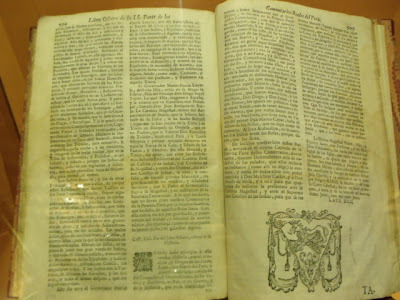
I got some nice books there, but I am most pleased with a facsimile edition of Garcilazo de la Vega's 1609 treatise, Primera Parte de los Comentarios Reales, que tratan del origen de los Yncas, reyes que fueron del Peru, de su idolatria, leyes, y govierno en paz y en guerra: de sus vidas y conquistas, y de todo lo que fue aquel Imperio y su Republica, antes que los Españoles passaran a el.  That book, known in English as the Royal Commentaries, was a landmark history and description of Inca Peru as it was the first written by a descendant of the subject of the book - Garcilazo was descendant of Inca emperor Tupac Yupanqui.   Lima's Universidad del Pacifico decided to mark it's 40th year of publishing by printing the full-size facsimile edition of the book.

An original copy of the Comentarios Reales displayed in Garcilazo's childhood home in Cusco

On the way home Liz and I mused about the success of the book fair, which draws people in droves, day after day over almost two weeks, and hat makes such an event possible here, as contrasted to the USA where book fairs are smaller and shorter events, with far fewer publishers represented.

Tuesday, July 26, 2011

Pisco Day

Sunday was National Pisco Day and at the Circuito de Aguas there was a pisco and marinera festival, so we headed there to enjoy the fountains and have some pisco along the way.

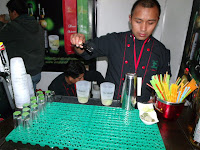
The city had shut down the large, record-setting fountain in the park and in the esplanade around it there had been set up a number of booths run by various pisco producers.    We got to try some pisco sours and classic chilcanos, but the stars were some chilcanos at the Sol de Ica booth prepared with pisco infused with fruits, vegetables, and herbs.   We tried a blackberry or mulberry chilcano that we weren't that impressed with, but we had our horizons expanded by a chilcano made with sweet basil leaves and cucumber slices, and a spicy one made with aji-infused and ginger-infused piscos.


In addition, we got to watch part of the game between the Peruvian and Spanish national sub-20 teams being played at the National Stadium next door, as it was broadcast on a giant screen at the water park.

Monday, July 25, 2011

Lima Water Park

Last night we -Liz, Diego, Rafa, Miranda, Jacho, and I- headed to the water park -the Circuito Magico de Aguas- as it was host to a pisco and marinera festival for National Pisco Day.

We had quite a time getting to the park as it also happened to be the night of the inauguration of the completely remodeled National Stadium, right nextdoor, with a game between the national youth soccer teams of Peru and Spain.   To make things worse, the president arranged for the national soccer team which placed 3rd in the Copa America in Argentina on Saturday to be at the stadium, so the crowds were huge inside the stadium and outside.


Eventually, we made it into the park after 9 o'clock and had a really nice time wandering through the gardens and enjoying the fountains.


Most of the fountains are strictly for viewing, some coreographed to music -as in the one in the video above- but there is one that is interactive and a perennial favourite:


No matter what the season or the weather it is always filled with young people trying their luck at avoiding getting soaked.

Rafa and Liz managed to get through with only their shoes getting wet, but Jacho got hit in the behind with a jet of water!


Friday, July 9, 2010

Plaza San Martin

As part of my visit downtown to watch the soccier match, Pocho and  I wandered a bit in Plaza San Martin.


Plaza San Martin is one of the emblematic spaces of "old" Lima.   It invariably turns up in old -and current- post cards, encyclopedia entries, and in old films about the city (for example, 1937's Glimpses of Peru).  However, the plaza is not particularly old, having been built less than a century ago, in 1921, for the 100th anniversary of Peru's Declaration of Independence from Spain, and the last of its buildings having been completed in the 1940s.

The central feature of the square is an equestrian statue depicting Gen. Jose de San Martin crossing the Andes from Argentina to Chile, leading an expeditionary force toward Lima, the seat of Spanish colonial power in South America.


A curious feature of the monument is that the crests borne on their helms by the odalisks at the north and south ends of the momument's base.   There is an amusing, but no doubt apocryphal story about that:  It seems that the monument's designer, the Spaniard Mariano Benlliure, comissioned Peruvian foundryworkers to execute the bronze elements of his design, who misunderstood him when he asked for a helm with a "llama" as a crest.   Llama, you see, means "flame" but it also refers to a certain Peruvian camelid species...


Plaza San Martin was  the centerpiece of Lima's growth into a modern capital.   Around it there clustered important economic and social institutions: Fenix -in its day one of Peru's largest insurance companies-, the Club Militar, the Colon theatre, the Metro cinema, cafes and restaurants.   Plaza San Martin and its environs also housed what were, in their day, the country's foremost hotels, the Crillon and, on the plaza itself, the Gran Hotel Bolivar.


The Bolivar was inaugurated on December 6th, 1924, to mark the centennial of the Battle of Ayacucho, the decisive battle in the fight for independence.  The hotel is said to have been originally named the Hotel Ayacucho, but when the President was reminded that the Quechua word ayacucho means "corner of the dead", it was decided to change the name to honor Simon Bolivar, another key figure in Independence.

The Bolivar was the country's first modern luxury hotel and as such it attracted it's share of wealthy and famous guests, notably Ava Gardner, who discovered the joys of the pisco sour in the hotel's bar.   Later on, the Rolling Stones were famously expelled from the hotel for overly raucous behaviour - only to be similarly expelled from the Hotel Crillon, a few blocks down Ave. Colmena.

The Bolivar hotel closed in the 1980s and remained so until a few years ago.  It has now been reopened as a three-star hotel and conference center.

In fact, the whole of Plaza San Martin has experienced a revival.    

For many years it was the hub of much cultural and social life. 

Even in the 1970s going to Plaza San Martin was exciting.   The big open space surrounded by imposing facades was thrilling, as was the activity and noise.  It just felt important.

We'd take a bus to the Parque Universitario walk a few blocks to Plaza San Martin.  Along the way, amid the banks, legal offices, and restaurants, we'd pass street vendors selling chunks of iron pyrite crystals, fossilize ammonites, and turquoise.  Booksellers would have the latest titles - Yo visite Ganimedes, and translations of Johnathan Livingston Seagull, von Daniken's Chariots of the Gods, and Chris: Portrait of a Teenage Alcoholic- laid out on cloths upon the sidewalk.

I remember there used to be a famous mime who would, each evening, entertain throngs of passersby with his satirical act at the base of the momunent.   The plaza was also the setting for endless debates between the left-leaning students of San Marcos University and the APRA-oriented ones of the Universidad Federico Villareal, both of which have campuses near the plaza.

Over time, however, white-collar social and economic life shifted away from downtown and toward Miraflores and, later, San Isidro.    At the same time internal migration to the capital put a population pressure on downtown, choking its streets with vendors, beggars, and petty thieves.   In the 1980s the government all but gave up downtown to the street hawkers.   Plaza San Martin became notorious for its prostitution dens and resident glue-huffing juvenile delinquents (pirañas).

In the late 1990s, however, under mayor Alberto Andrade, efforts were made to "recover" Lima's historic center.   Street vendors were cleared from the streets, the facades repainted, sponsorships were found to restore old buildings, and slowly since then, as subsequent mayors have continued the efforts, ait has again become a place that Limeno's often feel proud of.

Friday, June 18, 2010

Lima in 48hrs

No, it doesn't mean that I'll be in Lima in forty-eight hours, it'll be a bit more than two days, although the count-down is on.

What it's about is that, shortly before she died, my mom and I were talking about upcoming events in Lima, and in particular the fact that due to a family event in July, we'd have a number of people in town who'd likely have a day or two at most to spend in Lima.   Mom asked me to come up with an itinerary I'd follow had I to show someone around who had but two days to get to know the city.  So here it is.

I should mention that, for our purposes, I have assumed that the prospective traveler will be lodging either in Jesus Maria (e.g. with the family), Lince, San Isidro or Miraflores, four districts where hotels and hostels are clustered, and from which all the places mentioned are easily accessible.  I have also assumed that neither of the days falls on a Monday, when many establishments shut their doors and take a day off.

Lima is full of museums, quality restaurants, fun bars, and shopping opportunities, so there is actually much to chose from. However, I have been to and enjoyed all of the places suggested and thus can recommend them with confidence to foreign visitors.

 __________________________________


DAY 1

Morning
Breakfast at lodgings or go out to nearby café.  For something fairly Peruvian order a sandwich de chicharrón.  If you’d like juice, try a surtido which is made from a mixture of fruits and vegetables.  'Juice' is jugo, but be sure to order an extracto, as that is the pure juice with no water added.

Start your visit to modern Lima by getting acquainted with a bit of its past, at the National Arqueology, Anthropology and History Museum in Pueblo Libre.   The museum's displays run the gamut from remote prehistory, through Inca gold, and the Spanish Colonial and post-Independence periods, indeed up to the early 20th century.  Attached to the museum and housing some of the displays is the Lima home of Simon Bolivar, the key figure in winning South America's independence from Spain.  While not as impressive in some respects as the Museo de la Nación, this museum is smaller, calmer, more intimate, and is set in a quiet, historic district with older architecture, a nice plaza, and far less traffic.

Afterward, walk one block over to the Antigua Taberna Queirolo to sample the pisco and wines they produce there.

Next, off to San Isidro and the reconstructed pre-Inca pyramid of Huaca Huallamarca before heading to lunch.


Lunch
On this first day, get an idea of all that Peru has to offer by sampling a Peruvian buffet at Puro Perú in Barranco. 


Afternoon
After lunch, head to downtown and Lima’s historic center.   Have your ride drop you off at the Parque de la Muralla.  This park was built to showcase the recently discovered remains of the city's Colonial defensive wall.

From the city wall, walk to San Francisco Monastery and take the tour of the monastery and catacombs.   Be sure to not leave without buying some ground corn out front and feeding the pigeons.

Walk a couple of blocks straight down Jiron Ancash, then turn left on Jiron Carabaya toward the Plaza de Armas, Lima’s main square.

There, view the 1648 Baroque fountain, the Presidential Palace, the ornate balcony of the Archbishop’s Palace, and tour the Cathedral.

If you like, you could head back up Jiron Carabaya, to the right of the Presidential Palace, and -following the example of intellectuals, politicians, and even Presidents, of years past- duck into the century-old Bar Cordano for a pick-me-up before heading home to rest up a bit.


Evening
You'll likely be tired and not soon hungry after that lunch, so rest up and plan on heading out around 8. 

For dinner in a truly unique, if small, setting, head to the Blue Moon in Lince.  The place is decorated with a collection of almost 2000 wine, alcohol, and soft drink bottles, of the most varied types and shapes.  It has been a steady family favorite over four decades -for the ambiance and the food.


Late
Close out the evening at a peña.  The quintessential one is Brisas del Titicaca.  It offers a polished and colorful floor show of dances from all over Peru, as well as the opportunity for one to get in some dancing of one's own.   It has been around for decades and is very popular with tourists and locals alike, so tickets can be hard to get at the door.  Call ahead for reservations, and be prepared to stay up late.


DAY 2


Morning
Breakfast same as yesterday, but maybe try a different locale. However, after staying out late, you might sleep past breakfast altogether.

Either way, greet the day with a a peaceful stroll through the historic grove of El Olivar in San Isidro, or along the clifftop bulevár of Miraflores with perhaps a stop in Larcomar shopping center.


Afternoon
As there few things better for overcoming the effects of a late night out than cebiche, head for lunch to Pescados Capitales for some of the best food in town. 

Afterwards, have your ride take you to the "Indian Markets" (mercados indios) in Miraflores for some of the best crafts, jewelry, art, antiques, and bargain shopping in the city.

In the late afternoon,  after putting away your purchases, head to Barranco and to the Mirador, or overlook, across the Bridge of Sighs and at the point past the church, for some cocktails while watching the sun go down over the Pacific Ocean.


Evening
After strolling through historic Barranco, head to Panchita restaurant, on Avenida Dos de Mayo in Miraflores.  The food is very good indeed and the drinks menu imaginative.    

Afterward, head back to downtown Miraflores and Parque Kennedy.   There are often performances in the park during the evenings, and there is a nightly flea market which is usually well worth a look.

Alternately, head to the Parque de la Reserva and experience the water and lights spectacle of the Magical Waters Circuit.


Late
Finish out the evening with pisco sours and music on Miraflores' lively "Pizza Street".

Or, for something a bit more upscale and more sedate, head either to Bravo Restobar on Conquistadores in San Isidro for late night drinks, or to the cocktail lounge at Cala restaurant, which is located right on the seashore along the "Costa Verde".

Monday, February 18, 2008

Magical Waters


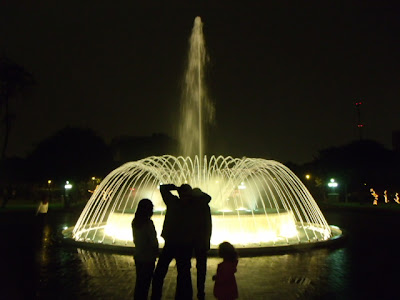
These pictures are of the Circuito Magico de Aguas (Magical Water Circuit) in Lima's Parque de la Reserva, near the National Stadium. When we were there in August construction was still going on, but they finished it in time for the warm austral summer evenings.
According to the brochure Liz brought back, the circuit consists of 13 fountains, the tallest which reaches 80 meters and has won distinction as the world's tallest public fountain. Liz says that the interplay of water and changing lights is breathtaking and truly magical, and a must-see for visitors to Lima.


Sunday, August 12, 2007

Miraflores

Lima is subdivided into districts, each with its own mayor and municipality - all of course subject to the mayor and municipal authority of metropolitan Lima. The district where we live in Lima is Jesus Maria, but one that we like to visit every time we go is Miraflores.


At one time, long ago, Miraflores was a suburb of Lima. Almost a separate town, in fact. Today it is an integral part of the city, harboring a number of hotels, restaurants, and banks. It is the hub of the city's middle class night-life, with cafes, bookstores, art galleries, some of the best restaurants in the country, and upscale shops, including the very nice seaside shopping mall of Larcomar.


Miraflores has served the city well in this regard, with venerable institutions such as the Pacifico movie theater (the first to have air conditioning), the Haiti cafe (it's been there for 47 years), and the Tiendecita Blanca cafe (been there for 70!).

The Tiendecita Blanca used to be the spot where my mom would meet friends for tea once a month to get away from the rat race, and where she meets them still when she visits. The Haiti has been there so long, that for many Miraflores would not be Miraflores if the Haiti were gone.

At the heart of the district, however, is Parque Kennedy, a trapezoid of greenery amidst the traffic and bustle. One of the attractions of the park is the nightly craft and antiques market.


The kids like it (as do I) because they can get cool stuff for relatively cheap prices there, and it's just fun to look around.

I also like it because there's always a good chance of running into this guy:


It's Mario Poggi (you may not recognize him without the green hair).

Mr. Poggi apparently is very intelligent, artistic, speaks several languages, graduated with very high rankings from several universities, and is a killer.


Until 1986, Poggi worked as a police psychologist. In that year Lima was shaken by a serial murderer who quartered his victims and littered remote areas of the city with the remains. Angel Diaz Balbin was captured as a suspect and Poggi assigned to analyze him. In the course of his analyses, Poggi became convinced that Diaz was the feared "descuartizador" and garroted him with a belt.

After serving four years in a psychiatric ward Poggi -now universally known as "el loco Poggi"- rejoined society as Lima's most noted eccentric. For example there is a video on the web of him stark naked in a shower in which he declaims about sex, the government, and other subjects. He has given his children by a new marriage names like Neurona H2O, and is said to have crashed social events dressed as the Viceroy Amat.


On a previous encounter I bought his book, Yo solo se que soy un imbecil, in which he includes a sketch of "How I killed the descuartizador." He signed the book for me and included his telephone number.

I've never dared call.


Another Miraflores institution is Calle San Ramon, better known as "la calle de las pizzas," or Pizza Street.


Pizza street is so called because virtually every groundlevel joint on this one block alley is a pizzeria. It is pretty sedate during the day, but at night the place comes alive.


The patrons show up and the barkers come out to lure you into their employers' restaurants with offers of discounts, complimentary pisco sours, or cheap beer. The food's not great, the sangria worse, but the atmosphere and energy can't be beat.


Arrive late, stay late. Then, maybe, just move a few doors down.

That's what we did on Ceci's last full night in Lima, moving our center of operations to one end of the street and into the Old Pub.


Ceci, Gina, Susana

My cousins Juancho, Mito, and Ceci


The Old Pub has been there since ... oh... 1997. It has great character and is very cozy place to have an after-dinner beer.

In any case, there's always another place right next door...