Showing posts with label San Isidro. Show all posts

Sunday, August 3, 2025

Eating Gluten-Free in Lima, Peru


A few years back I did a post on dining gluten-free in Peru, particularly in Lima. (Read it HERE

Today, the same recommendations I made then still apply.   Happily, however, the situation is improving quite a bit. 

There is now a small chain of grocery stores, Flora y Fauna, that has many gluten-free offerings - breads, cereals, pastas, pastries, and other items.  Many of the products they carry are also dairy-free, organic, or vegan.


In general supermakets, it is now harder to find gluten-free items, even though they are still somewhat available, because most seem to have done away with dedicated gluten-free and "healthy" shelving, and just mixed those products into similar categories. 

The bigger food companies comply with EU labeling standards and so are pretty good at listing allergens and shared equipment. 

Previously I had stated that Braedt charcuterie was gluten-free, but I have inquired again and this time got the response that they could not assure that their products were gluten-free.  However, there is now a line of good quality charcuterie available in supermarkets from the Casa Europa brand which are almost all labeled as gluten-free.

Dining out has become a bit easier.  Servers and cooks seem more aware of allergens and are clearer on whether they can accommodate special needs.  Their suggestions aren't always the most creative, but they make an effort.

We did find two places that make gluten-free dining fairly easy.

One is Limaná restaurant, in San Isidro.  Almost all of their menu is gluten-free, including gyozas, desserts and pastries, and the staff is knowledgeable and very friendly.  We've dined there a few times, and had good meals every time.  The prices a bit high, specially for the portion size (compared to many other Peruvian eateries) but the ability to just relax and have multiple gluten-free offerings  makes up for that.


Some of the gluten-free offerings at Limaná

Another spot is Armónica Café in Miraflores.  Most of their menu is not gluten-free, but they have a selection of gluten-free pastries, including alfajores, truffles, cookies, brownies, and more, and good coffee to go with them.

Armónica Café
 

Armónica is located on Avenida La Mar, which is a center for dining, with many well-known restaurants nearby, so it is a good option for an after-meal coffee and dessert.

Speaking of which, Armónica Café is walking distance from Pescados Capitales, where one can not only enjoy good cebiches (all naturally gluten-free) and excellent pisco sours, but also, we have discovered, a tasty gluten-free dish of grilled paiche (also known as "arapaima" outside of Peru).  The dish is called "Lujuria" on the menu.


Another recent discovery is the Rinconcito de Tiabaya restaurant in Surquillo.   The place is set up as a traditional picantería and serves the cuisine of the southern region of Arequipa.  It is not a gluten-free space but it has many dishes that are gluten-free just because the ingredients are such.  These will be basically fried meat cuts accompanied with salad and potatoes, and few othe dishes as well.  We were assured that the fryer is dedicated and only meats go into it so there is no cross-contamination, and the staff were very attentive to our needs.


The ability to order a full meal (portions are big), enjoy tasty traditional foods, have multiple options, and not have to leave something off or do without some part of it was nice.  


Monday, July 24, 2017

Lunch at Astrid & Gastón


Last week, leading up to my birthday, I followed Liz's suggestion and treated myself to lunch at Astrid & Gastón.

Astrid & Gastón, the brainchild of pâtissière Astrid Gutsche and chef Gastón Acurio, is consistently ranked as one of the world's best restaurants. It has been on the San Pellegrino list of the World's 50 Best Restaurants since the list was launched fifteen years ago. (It is currently ranked #33 in the world, and #4 in Latin America.)

Liz and I have eaten there previously, treating ourselves to the tasting menu, when the restaurant was at its original home in Miraflores.  A few years ago Gutsche and Acurio moved it to the Casa Hacienda Moreyra in San Isidro.


Originally, the idea was that the space would hold two restaurants: one with a more casual vibe, and another which would be the actual Astrid & Gastón.  That scheme has been dropped and, although the two different dining spaces remain, the same Astrid & Gastón menu is offered at both.

This time around I ordered a few dishes à la carte.


House-made breads with, from L to R, guacamole, smoked tomato butter dusted with tomato ash, house-made butter.

Scallops with a pesto dressing and dusted with apple ice.

Sea urchin roe on toasted brioche.

Roasted guinea pig with corn cream, huacatay sauce, quinoa, and purple corn humita (basically a sweet tamale)

A couple of mini desserts that came with my coffee.

Of course, everything was delicious and the service was great. I left there a pretty happy guy.


Monday, July 4, 2016

La Casa restaurant


On one of my first days here, Jose --who was in need of company for lunch-- came and rescued me from having lunch alone myself, and took me to a new restaurant opened by a friend of his.

La Casa ("The House"), located in San Isidro district, is still in its soft opening phase, but it is well on its way.  The food is solidly prepared --the conchas a la parmesana were some of the best I've ha, and the carapuclcra, which is made from freeze-dried potatoes, was very flavorful and smoky, showing that the cook knew how to prepare it in the highland way, by toasting the dried potato before rehydrating it.

Our only criticisms were of the wait staff and the decor.  Our waiter forgot to mention the specials, and when asked about them he was rather perfunctory.  With training that is something that can be fixed.

As for the decor, it isn't so much a criticism, but rather noting of a missed opportunity.  While La Casa is welcoming enough, if they had played up the house theme a bit more by, for example, mixing up furniture, with a few couches or arm chairs, "family" photos, lamps, etc., they could have made the place a bit more of an experience.  I have no doubt that they'll do fine in pulling the lunch crowds, but I think they've potentially missed the opportunity to make the place a nighttime destination spot.

In any case the food and drinks are worth visiting the place.

Conchas a la parmesana

Tequenos de lomo (won ton skins with beef filling)

Escabeche de pescado

Carapulcra


Thursday, June 27, 2013

Bravo Restobar


Last night, after leaving the clinic after visiting my nephew, and his girlfriend and their beautiful newborn girl, Liz, Jacho, Jose, Carla and I headed to Bravo Restobar for drinks and dinner.


Bravo Restobar, the creation of chef Christian Bravo, is a steady element in the Lima restaurant scene, and -as the autographed walls attest- it is frequently a stop for international pop stars and other personalities. The food incorporates Peruvian dishes and ingredients with touches of Asian and "international" cuisine.

Of course, we started off to drinks: some mojitos, pisco sour, caipirinha, and a signature drink which was akin to a chilcano, but made with a touch of ginger and star anise, and colored with ayrampo, a small cactus fruit used to color foods in the Andes.

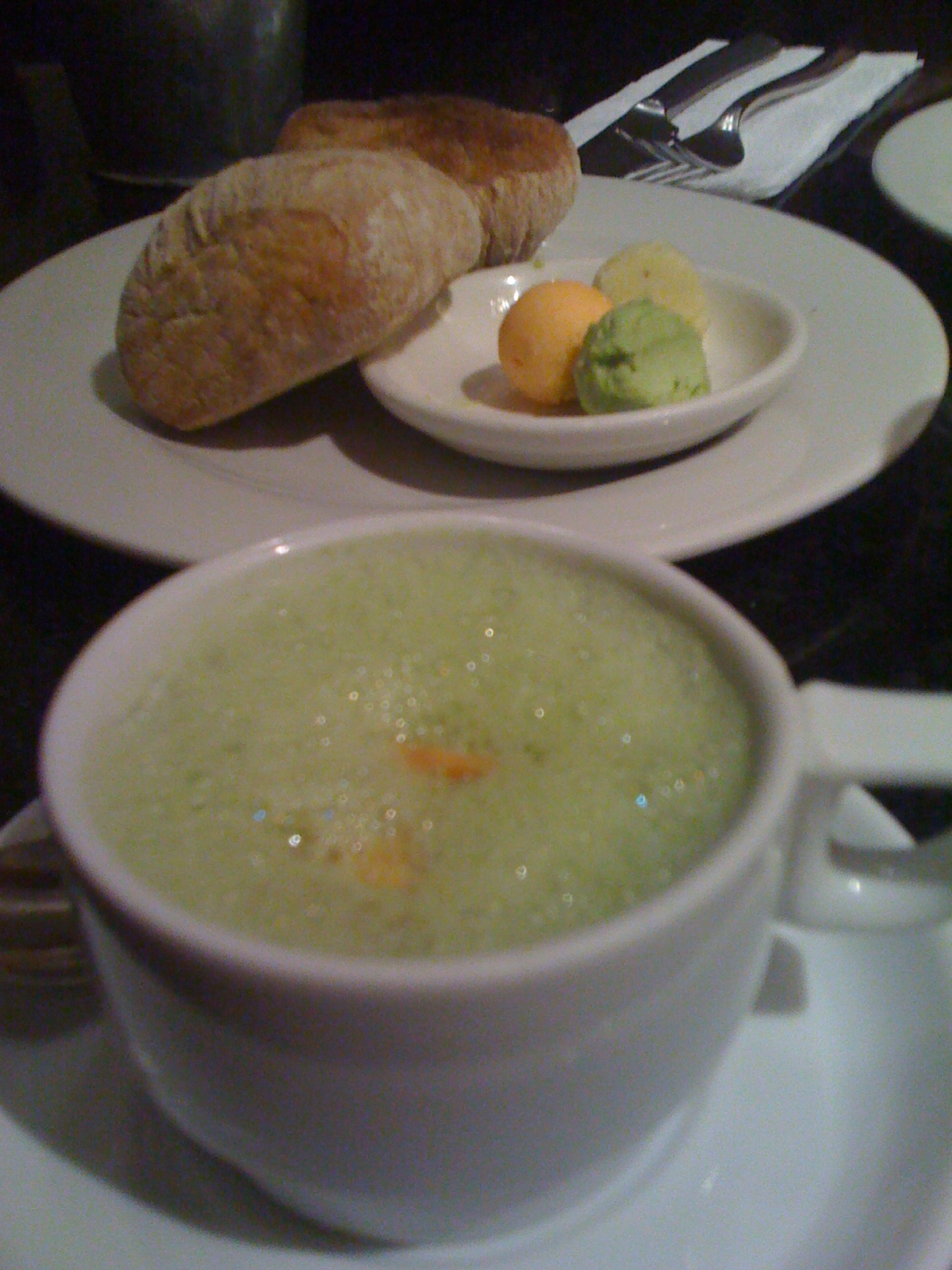
This was followed by complimentary freshly baked breads with a trio of flavoured butters, some flat-bread chips with a huacatay-infused dipping sauce, and little cups full of a delicious Andean potato soup.

Our choices included a very tasty lomo saltado.  As I have mentioned elsewhere, lomo saltado - a sauteed mix of beef, tomatoes, onions and potatoes, with an Chinese touch- is a classic dish of Peruvian home and restaurant cooking.  It is very much comfort food for Peruvians, and any restaurant worth its salt will have it on the menu.   Of course, that makes it hard to impress Peruvians with a lomo saltado, as few will find one to be as good as mom's or that of their favourite hole-in-the-wall restaurant.

Bravo's lomo saltado did not disappoint.  The seasoning was right on, and the dish was upscaled a bit by the addition of mushrooms.   Even though it had the tubers on the side instead of mixed into the sautee -a recent trend in restaurants here, and one on which there are definitely two school of thought - that "deficiency" (I side with those who feel that the dish is better with the potatoes mixed in)was more than made up for by the crispness of the fries and the inclusion of fried yuca root.  That saltado was definitely the star of the night's meal.


Bravo Restobar
Av. Conquistadores 1005
San Isidro - Lima

Thursday, July 19, 2012

Malabar


During a phone conversation with Liz, she convinced me to treat myself to lunch somewhere special for my birthday, so after a morning shopping in Chinatown, I invited Willy to lunch at Malabar.

On the way there, he decided that he wanted to treat me instead, which I naturally accepted, and we called Juancho and José to join us.


Malabar is a white-tablecloth restaurant in San Isidro's Camino Real area.  It is the brainchild of  Pedro Miguel Schiaffino, who is widely regarded as one of Lima's more inventive chefs.

The entrance is fairly nondescript, and there is nothing flashy about it.  In fact, it could be easily missed. Inside, however, is a very nice -and surprisingly comfortable- space.  The tables are impeccably appointed and -other than the bar area- the decor is subdued. 

The bar itself is incredibly well-stocked for a Lima restaurant bar, but perhaps the most conspicuous element is the large painting of two nude bathers that hangs over its seating area, directly facing the restaurant's entrance.


On a previous visit to Malabar, we noted that Schiaffino was focused on the flavours and ingredients of Peru's jungles.  In fact, it was on that fusion that he largely built his reputation.  Those elements are maintained still in a few dishes and but this time around Schiaffino had turned his attention to the Andes.  However, what we ate was not the typical "Novo Andina" fusion that has been done -and perhaps overdone- with varying degrees of success here.

For starters, while we waited for José and Jacho to arrive, they brought us a small bowl of traditionally toasted (no oil, no salt) cancha -dried corn kernels- accompanied by cubes of salty cheese from Ayacucho's Puquio province.


Next, when they brought out crusty bread, we were provided with little trays containing two tiles of piedra de Huamanga, a type of alabaster characteristic of Ayacucho's Huamanga province and long used in art and folk crafts in the region.   One of them was chilled and had a hollow filled with butter, the other had been heated to allow each of us to keep his piece of bread warm. (It didn't really work, but it was a nice idea.)

The food, as I've said, was not the usual Novo Andina fusion, in which chefs and cooks too often rely on heavy sauces.  Schiaffino's touch is much lighter and refined, as fits a restaurant that even in city with so many restaurants, and so many good ones at that, is marked as one of the highest-rated gourmet stops.

José ordered a dish of roasted suckling pig, which was crispy on the outside and moist inside, and Jacho had a dish of rabbit with a peanut polenta, which they both enjoyed.

Willy ordered a dish of rockfish -we thing it was a mero- over mushrooms and boiled Brazil nuts in a sage-infused gravy.  It was delicious, specially the sauce.

My own selection was a piece of paiche -a large jungle fish- in a sauce made with masato and topped with black tapioca.  It was very nice although kind of hard to eat with a fish fork and still enjoy some of the sauce in each bite, so I asked for a spoon.


To finish the meal we ordered the selection of traditional Lima desserts.  Clockwise from the center: suspiro de limeña, arroz con leche, picarones, mazamorra morada, and lúcuma ice cream.

As I said, today was a day of culinary indulgence.  And there was yet more to come ...

Wednesday, June 27, 2012

La Botica

In Spanish, botica means drug store, and such is the name of a small bar/restaurant that my namesake cousin Juancho took me to last night.

It was new to us both -Juancho had read about it the newspaper- and we were both very pleasantly surprised.

La Botica is located in the site of a longtime drug store and pharmacy, Farmacia Maggiolo, on Ave. Petit Thouars in San Isidro district.   The owners visited other classic Lima bars and taverns and it is evident that they learned well.  La Botica has been open since October but it feels like it's been around forever.  It has that feel of old times that one gets in venerable places like the Taberna Queirolo or the Bar Cordano.

The drinks menu is pretty slim and standard -pisco sours, chilcanos, cosmopolitan, martini, and so on- but well-prepared.  The food and appetizer menu is also smaller than at some other establishments, but it is well-thought out and well-prepared as well.

We started with pisco sours made with different brands of pisco, and a papa rellena.  Papa rellena consists of a meat stuffing rolled inside a ball of mashed potato, which is then fried to give it a crisp exterior.  La Botica's was good, not great, but no one would be ashamed to serve it to guests.  The second round of food, however, was exceptional.

The dish, Mollejitas de mi suegra (My mother-in-law's gizzards), consisted of chicken gizzards served bathed in the cilantro-laced sauce typical of the stews served in the north coast.  I don't know what they did to them, but the gizzards were fork-tender and buttery.  It was surprising and delicious.  The decision to pair the gizzards cooked that way with the norteño gravy was inspired.

The staff was friendly and efficient.  We chatted with the owner for a bit, and he later sent out a comped dish of olives for us.

La Botica definitely merits a visit.  I predict that it will become one of Lima's favorite bars as word of it spreads.


La Botica
3910 Ave. Petit Thouars
San Isidro, Lima

Wednesday, August 4, 2010

Toshiro's

Well, all the visitors have gone back to the US, save only dad and I, and I've got just until Friday night, so I've had to at the same time try to fill my days, and prioritize things so that what I do end up doing is worthwhile.

So, one of the things I decided to do yesterday was take myself to lunch at a place that I'd been curious about for some time: Toshiro's sushi in San Isidro.

The first thing I noticed was that the signage had been changed from Toshiro's Sushi Bar to Toshiro's Japanese Restaurant - yes, like that, in English.   I presume the change also reflects a change in focus for the restaurant, as sushi was a minor part of the menu.

My cousin Juancho, a foodie like his namesake, had peeked into Toshiro's once and disliked the ambience and thus had been resistant to going there on occasions when we've gone out for sushi.   The thing is that the restaurant occupies a mezzanine inside a casino and is not itself visible from the street.  Even though it has a separate entrance from the casino itself one must still pass through a small bar lobby, in full view of the slot machines, to reach the steps up to the restaurant proper, and it was that bar that he had seen.   Once inside the restaurant, however, it is as if the casino did not exist.

I was surprised to find the place empty of diners even though it was lunch time.  The itamae told me that it was fairly unpredictable but that on Mondays they tended to be full more often than on other days.  Anyway, it good for me as I was well-tended-to and I got to chat with the itamae.

I ordered a beer while I perused the menu at the sushi bar.   While in Lima -as in the California- most sushi restaurants focus on rolls and tend to be quite creative with the ingredients and extensive in their combinations, Toshiro's tends to focus its sushi on more traditional styles -nigiri, very simple makis (think tekka maki), chirashi sushi, and so on- fancy maki rolls occupy a back page in the menu and there are only eight or ten listed.   Now, don't ask me if it's Edo style or what else as I don't know, but the point is that the point of Toshiro's sushi is the fish.


 I started with a sushi selection, which is left to the discretion of the itamae based on what's available.  I was not disappointed.  The fish was very clean tasting and delicious.   At first one think's "that it?" but near the end of the plate one realizes that there is actually quite a bit there.

 I followed that up with a couple of pieces of uni - sea urchin roe.  The roe was from Peruvian waters, and my itamae explained that it was a lucky day in the urchin deparment as Toshiro Konishi, the owner and exective chef, is very picky about urchin roe, more often than not rejecting what other restaurants would gladly purchase.


In the US a lot of people seem to not like sea urchin. In part, I'm sure, it's that it's roe and that it's urchin, but the strong flavor of urchin roe available there must dissuade a big part of it's detractors.  If they'd tasted this uni, they'd likely change their tune.  The absolute freshness of this urchin made all the the difference.   I could still taste the ocean when eating it but it had no "fishyness" at all, rather an underlying sweetness and butteriness...  It was simply delicious.

As a parting courtesy, I was given an on-the-house cebiche of Peru's excellent scallops,  served with a dab of avocado, a mix of tartar sauce and grated maca root, and topped with tobiko.  It was a nice finish  to a fine meal.


Toshiro's Japanese Restaurant
Av. Conquistadores 450
San Isidro - Lima

Wednesday, July 21, 2010

Birthday lunch: Malabar

Monday was my birthday, and fortunately I was feeling human enough to start going out and doing stuff.   So, Liz, Nico, Diego, Sara and I went out to lunch.   It being my choice, I opted for Malabar, a restaurant I had been curious about for a while.

Malabar's cuisine is a bit hard to pigeonhole.   It is definitely in the vein of Novo Andina cuisine in fusing culinary academy -basically French, I guess- techniques and aesthetics with native ingredients and flavor.  In contrast to Novo Andina, which focuses on Andean and criollo ingredients and dishes, Malabar's chef has turned to Peru's Amazon hinterland for inspiration.   Consequently, the menu abounds with jungle fishes and fruits.

Part of what puts Malabar consistently at the top of Lima's restaurant lists is the quality of the experience.   The chef, Pedro Miguel Schiaffino, remains present and in charge of his restaurant.  In fact, he greeted us as we walked in.  The place itself is discreetly set into the ground floor of an office tower in San Isidro.  The windows are opaque and plain.   Inside, however, is a white-tablecloth restaurant decorated in a mix of jungle-like elements (stuffed impala heads over the bar), a collection of antique glass in a corner cabinet, and a large painting of a pair of swimmers clad only in swim caps. 

The food was very good indeed (although most Peruvians might complain that the servings are a too small).  Diego ordered a "dry soup" of shrimp, which was essentially a rissotto with an intense flavor of a classic Peruvian shrimp stew, chupe de camarones.   Nico had a rice and bean dish (tacu tacu) topped with a sautee of vegetables and seafood, which he declared excellent.  In fact he barely talked as he ate it!

Liz, on the recommendation of the waiter, selected a beef medallion with glazed vegetables. It was good, and tender as described, but she said she found a bit ordinary.


My selection, an inchi capi of paiche was perhaps the most interesting and surprising dish at our table.   Inchi capi is an Amazonian soup, usually made with chicken and thickened with corn meal and featuring yuca.  In Schiaffino's reinvention, the soup is a thin but intensely-flavored broth.   The corn shows up as crust on the serving of paiche, a large jungle fish, and the yuca as a tapioca topping on the fish and which adds texture to the broth as it is mixed in.


 Other notable dishes were some river snails and mushrooms atop a palmito puree and topped with shredded chonta palm, and a tiradito colored with ayrampo, a small cactus fruit long used as a colorant in the Andes.


Malabar is a very good restaurant and deserving of its reputation.  However, it is expensive and thus not a casually-made selection.   I don't know that I'd return, just on that account, but I enjoyed myself a lot and am glad to have tried it.


Friday, June 18, 2010

Lima in 48hrs

No, it doesn't mean that I'll be in Lima in forty-eight hours, it'll be a bit more than two days, although the count-down is on.

What it's about is that, shortly before she died, my mom and I were talking about upcoming events in Lima, and in particular the fact that due to a family event in July, we'd have a number of people in town who'd likely have a day or two at most to spend in Lima.   Mom asked me to come up with an itinerary I'd follow had I to show someone around who had but two days to get to know the city.  So here it is.

I should mention that, for our purposes, I have assumed that the prospective traveler will be lodging either in Jesus Maria (e.g. with the family), Lince, San Isidro or Miraflores, four districts where hotels and hostels are clustered, and from which all the places mentioned are easily accessible.  I have also assumed that neither of the days falls on a Monday, when many establishments shut their doors and take a day off.

Lima is full of museums, quality restaurants, fun bars, and shopping opportunities, so there is actually much to chose from. However, I have been to and enjoyed all of the places suggested and thus can recommend them with confidence to foreign visitors.

 __________________________________


DAY 1

Morning
Breakfast at lodgings or go out to nearby café.  For something fairly Peruvian order a sandwich de chicharrón.  If you’d like juice, try a surtido which is made from a mixture of fruits and vegetables.  'Juice' is jugo, but be sure to order an extracto, as that is the pure juice with no water added.

Start your visit to modern Lima by getting acquainted with a bit of its past, at the National Arqueology, Anthropology and History Museum in Pueblo Libre.   The museum's displays run the gamut from remote prehistory, through Inca gold, and the Spanish Colonial and post-Independence periods, indeed up to the early 20th century.  Attached to the museum and housing some of the displays is the Lima home of Simon Bolivar, the key figure in winning South America's independence from Spain.  While not as impressive in some respects as the Museo de la Nación, this museum is smaller, calmer, more intimate, and is set in a quiet, historic district with older architecture, a nice plaza, and far less traffic.

Afterward, walk one block over to the Antigua Taberna Queirolo to sample the pisco and wines they produce there.

Next, off to San Isidro and the reconstructed pre-Inca pyramid of Huaca Huallamarca before heading to lunch.


Lunch
On this first day, get an idea of all that Peru has to offer by sampling a Peruvian buffet at Puro Perú in Barranco. 


Afternoon
After lunch, head to downtown and Lima’s historic center.   Have your ride drop you off at the Parque de la Muralla.  This park was built to showcase the recently discovered remains of the city's Colonial defensive wall.

From the city wall, walk to San Francisco Monastery and take the tour of the monastery and catacombs.   Be sure to not leave without buying some ground corn out front and feeding the pigeons.

Walk a couple of blocks straight down Jiron Ancash, then turn left on Jiron Carabaya toward the Plaza de Armas, Lima’s main square.

There, view the 1648 Baroque fountain, the Presidential Palace, the ornate balcony of the Archbishop’s Palace, and tour the Cathedral.

If you like, you could head back up Jiron Carabaya, to the right of the Presidential Palace, and -following the example of intellectuals, politicians, and even Presidents, of years past- duck into the century-old Bar Cordano for a pick-me-up before heading home to rest up a bit.


Evening
You'll likely be tired and not soon hungry after that lunch, so rest up and plan on heading out around 8. 

For dinner in a truly unique, if small, setting, head to the Blue Moon in Lince.  The place is decorated with a collection of almost 2000 wine, alcohol, and soft drink bottles, of the most varied types and shapes.  It has been a steady family favorite over four decades -for the ambiance and the food.


Late
Close out the evening at a peña.  The quintessential one is Brisas del Titicaca.  It offers a polished and colorful floor show of dances from all over Peru, as well as the opportunity for one to get in some dancing of one's own.   It has been around for decades and is very popular with tourists and locals alike, so tickets can be hard to get at the door.  Call ahead for reservations, and be prepared to stay up late.


DAY 2


Morning
Breakfast same as yesterday, but maybe try a different locale. However, after staying out late, you might sleep past breakfast altogether.

Either way, greet the day with a a peaceful stroll through the historic grove of El Olivar in San Isidro, or along the clifftop bulevár of Miraflores with perhaps a stop in Larcomar shopping center.


Afternoon
As there few things better for overcoming the effects of a late night out than cebiche, head for lunch to Pescados Capitales for some of the best food in town. 

Afterwards, have your ride take you to the "Indian Markets" (mercados indios) in Miraflores for some of the best crafts, jewelry, art, antiques, and bargain shopping in the city.

In the late afternoon,  after putting away your purchases, head to Barranco and to the Mirador, or overlook, across the Bridge of Sighs and at the point past the church, for some cocktails while watching the sun go down over the Pacific Ocean.


Evening
After strolling through historic Barranco, head to Panchita restaurant, on Avenida Dos de Mayo in Miraflores.  The food is very good indeed and the drinks menu imaginative.    

Afterward, head back to downtown Miraflores and Parque Kennedy.   There are often performances in the park during the evenings, and there is a nightly flea market which is usually well worth a look.

Alternately, head to the Parque de la Reserva and experience the water and lights spectacle of the Magical Waters Circuit.


Late
Finish out the evening with pisco sours and music on Miraflores' lively "Pizza Street".

Or, for something a bit more upscale and more sedate, head either to Bravo Restobar on Conquistadores in San Isidro for late night drinks, or to the cocktail lounge at Cala restaurant, which is located right on the seashore along the "Costa Verde".

Sunday, June 28, 2009

Sunday, August 3, 2008

El Olivar

As our days in Lima wound down we fulfilled a request from Nico and spent an afternoon strolling through the El Olivar Park in San Isidro after visiting Huallamarca. El Olivar is a 400-year old olive grove in the middle of San Isidro district and an oasis of calm and nature in the midst of the city. It was established in the late 1500s from seedlings brought from Spain, and some of those original trees still survive on the grounds, which were once the domain of the Counts of San Isidro.

One of El Olivar's more endearing features is that its 23 hectare extension offers a haven for multitudes of birds, and the park features bird identification charts along its central walkway.


For the more history-minded there survive the ancient press and a huge earthenware porongo once used in olive oil production at the site.


We rounded off the afternoon by walking a couple of blocks to the San Isidro traffic circle (ovalo) and a stop for coffee and hot chocolate at the Casa Hacienda Moreyra.


This restaurant is located in what was once the main house, built in the 1700s, of the hacienda of the Counts of San Isidro, and later of the Paz Soldan and Moreyra-Paz Soldan families. The place is filled with antiques and the exudes a sense of luxury from days gone by.

The food is reputed to be quite good. I think someday we'll have to return for a real meal in this wonderful setting.

Huaca Huallamarca

Huallamarca is a huaca ("precolumbian ruin", but lit. "holy place" in Quechua) in Lima's San Isidro disctrict. It used to be known also as Huaca Pan de Azucar and can be found referenced in older books about Peru as the "Sugar Loaf," which is what pan de azucar means.

Huallamarca was occupied in the second century BCE, and construction of the first structure on the site seems to have ocurred by about 400 CE, which makes it probably the oldest man-made structure in Lima.

Huallamarca was abandoned as a ceremonial centre two centuries later, which seems to coincide with the building of the Huaca Pucllana a few miles to the south, in Miraflores. It was then used as a cementery by a succession of cultures. Remains of Maranga, Chancay, Lima, and Huari-Tiawanaku-influenced peoples have been found. When the Inca arrived on the scene in the 15th Century the area was occupied by a people called the Hualla, hence the name given to the site: Hualla + marka (place of).


Lima-style ceramic depicting a feline, but it remided us of Diego's dog, Kafu


Spondylus shells.
These only grow in the warm waters near the border with Ecuador.


Funerary masks of wood with shell eyes.


The huaca is located at Nicolás de Rivera 201 in San Isidro, and can be visited daily (except Mondays, when it is closed) from 9:00 am til 5:00 pm.