Showing posts with label Cusco. Show all posts

Wednesday, July 22, 2015

Craft Beer Stand at the Lima Book Fair

I had a hard time at the book fair, I must say.

The fair is set up under a tent erected over the central part of park, covering a fountain and a number of steps.  The floor is thus of plywood sheets over a frame, and covered with carpeting, all of which makes in a bit uneven in many spots.  With my aching and sensitive knee, it made walking difficult, and even a bit perilous.   It was also very hot under the tent, and my off-gait was causing me to expend extra effort as it was.


Fortunately, there is a craft beer stand in the food court, set up and run by a small distributor representing four small breweries - three from Lima and one from Cusco.


I chose two beers to try.

First, I opted for the Ayrampo Roja from the Sacred Valley Brewery, whose beers I had never tried before.


The Ayrampo Roja (6% ABV, 35 IBU) is a red beer (hence the roja) coloured with caramel malt and the fruit of the ayrampo cactus, which is native to the Peruvian Andes and has long been used to color foods in the highlands.  The beer was good, and there was no ayrampo flavour (it can taste a bit like red beets).

Next, I went for one from the Cumbres brewery.  I have tried one other of Cumbres' beers, their Quinoa Kolsch, so I was anxioux to try another of their offerings.


I opted for the Maracumanto (6.2 % ABV).   Maracumanto is a Belgian Pale Ale, fermented with maracuuyá and aguaymanto  fruit.   I half expected it to be sour, owing to the presence of the maracuyá, but it was not sour at all.  It was actually very refreshing, and relatively low in fruit notes in the mouth, even though they came through in the nose.

Needless to say, I then felt quite refreshed!

Wednesday, June 20, 2012

Video: Takanakuy

Another one. This time it's about the custom of takanakuy.

In the province of Chumbivilcas, in the Cuzco region, Christmas is celebrated with partying, drinking, fireworks -like in the rest of Peru.  What makes chumbivilcano Christmas different is the takanakuy, which is a festival of ritualized hand-to-hand combat. 

Fights are one-on-one bareknuckled fistfights accompanied by huaylia music, and all strata in the community take part -men, women, young, and old.  Even kids.  Through  the takanakuy grudges are settles, stress is released, community harmony is retained, and the Earth is repaid for her bounty through  the fighters' sacrifice.

In this video, the host, Thomas, travels to Chumbivilcas to witness and participate in the takanakuy.


PART ONE:


PART TWO:


Tuesday, July 19, 2011

Devils on the rooftops

In Paucartambo -and in other Cusco towns- during the feast days of the Virgen del Carmen, in mid-July, dance troupes associated to specific religious fraternities take to the streets and, through their dances, essentially act out religious plays.     One set of important characters in these are the saq'ras, or devils, who haunt the streets surrounding the church -being unable to enter it- and on the last day of the festival, when the effigy Virgin is carried in procession through the streets, the saq'ras are reduced to haunting the rooftoops and treetops, emiting their trilling cries, and waving their canes at the Virgin and her worshippers.

In Cusco, on the afternoon of the 7th, as part of the celebrations of the 100th anniversary of the "discovery" of Machupiqchu, Cusquenos made an effort to bring out elements of their folklore.  Accordingly, we found a troupe of saq'ras haunting the Plaza Espinar and the Basilica de la Merced.

As Liz said at the time, we were pretty lucky to have chosen those days to be in Cusco!


Saturday, July 16, 2011

Cusco: Celebrations

While we were in Cusco there was celebrated the 100th anniversary of Hiram Bingham's announcement of the existence of Machupiqchu.   As part of the celebrations -aside from a ceremony and concert in Machupiqchu itself- there were musical acts and a concert in Cusco's main square.

Some of the acts were folkloric dance groups, called comparsas.   The first of the below is from Cusco's Paucartambo province, and the sencond, from Puno.


Friday, July 15, 2011

Maras

Our last stop in the Sacred Valley was a spot on the western rim that I had been curious to visit for some time: the salineras (saltworks) at Maras.   The normal tour of the northern part of the valley passes through the market at Pisaq -skipping the ruins-, lunch at Urubamba, the ruins at Ollantaytambo, and the market and church in Chinchero- but I had instructed our hired driver -a really nice guy named Javier- to skip Urubamba and Chinchero- and make sure to get us to Maras.

The Maras saltworks have been in operation since Inca times and likely well before that.  One side of the little valley where they are located has been terraced and the terraces are filled with salt water that emerges from a single spring in the mountainside.

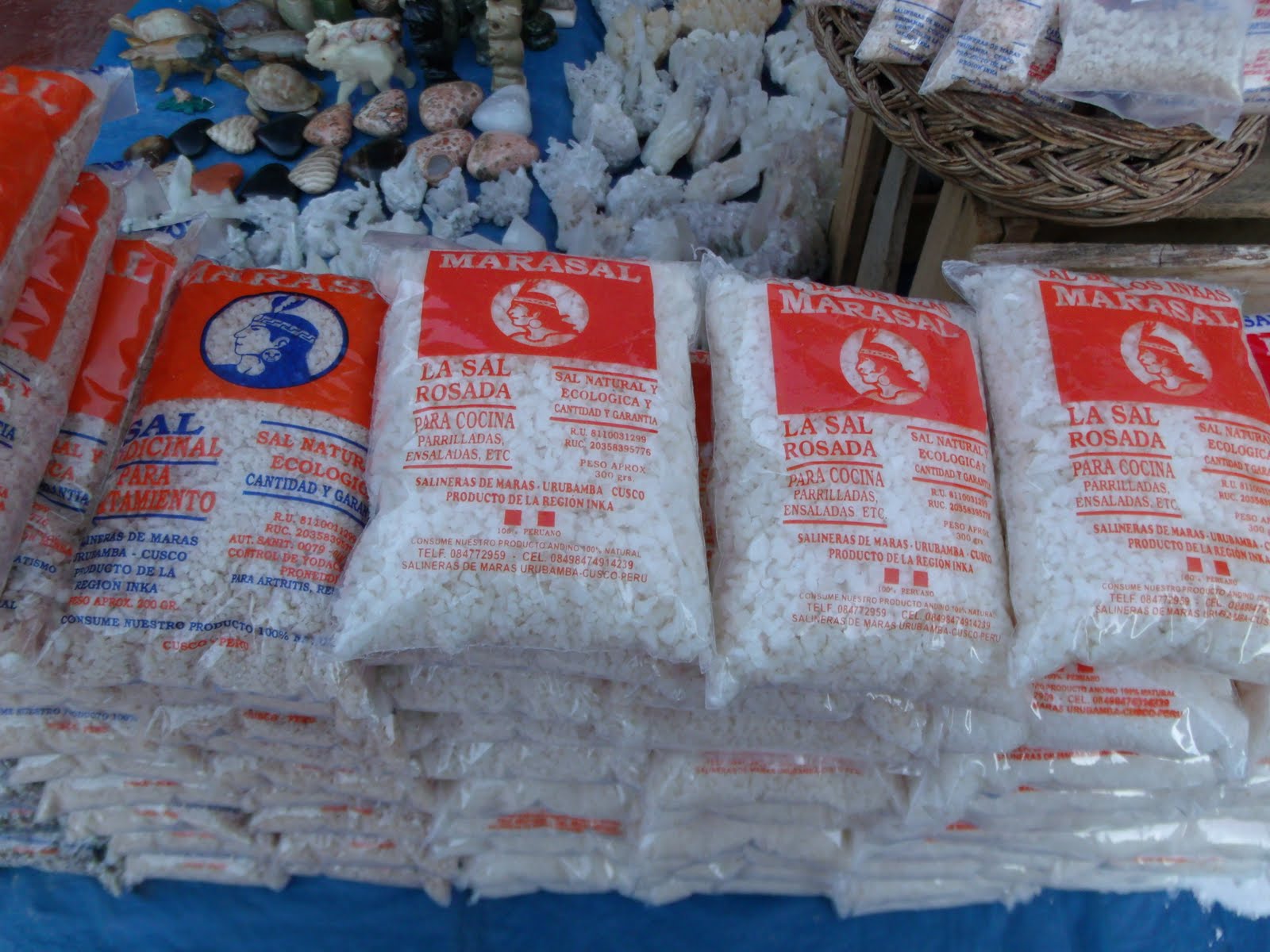
Each family controls 10 to 20 pans. The salt spring's water is channeled and diverted so that all the terraces' pans are filled, and the water is allowed to evaporate and the salt to concentrate, until it forms a layer thick enough to be harvested.  The salt is then bagged and shipped out to market, mostly for agricultural use, though some -mainly from the purer top layers is packed in small amounts, labeled, and sold in Cusco, and at the works themselves, for medicinal and culinary use.

We bought about a half kilo of salt to bring back to US with us and some to leave here in Lima.  The salt is not "sweet" like fleur de sel nor minerally like Indian kali namak.  The overall impression is of ... well, ... saltiness.


Wednesday, July 13, 2011

Pisaq

Our first stop in the Sacred Valley was in the town of Pisaq.    Pisaq is a market town, famed for its Sunday fair, which is held in the town's main square, dominated by a large and venerable pisonay tree.  The tree is a distinctive feature of the town, and it has been there so long that it is nearly impossible to think of Pisaq without it.   The town is easily identifiable in early photographs because of the tree.


Pisaq was established by the Spanish in the 1500s but it lies at the foot of the Inca site of Pisaq.   Before asking our driver to take us up the mountain to the ruins, we did a bit of shopping, buying some masks to decorate our Lima apartment with.

In that regard I have to mention the service we received at Artesanias Pisonay on Pisaq's main square.  When we were short of cash, the owner offered to take a small deposit and deliver the masks to our hotel the next day.   Granted, by buying four of their more expensive masks, we were likely making their week's sales in one day, but Alicia, the owner, really did go out of her way to help us get what we wanted.  She made a special trip to Cusco, and arrived when she said she'd be there (in fact she apologized for being 10 mins "late", which most of time in Peru doesn't even count!)  She even brought the packing materials we had requested.


In any case, after that, we moved to visit the ruins of Inca Pisaq.


No one is quite sure who ordered Inca Pisaq built or when, but it seems likely that it was established in the the 1470s or thereabouts, and was perhaps intended to mark the Inka Pachakutiq's triumph over the tribes of the Antisuyu.   It had a clear agricultural purpose, what with its numerous terraces encompassing an area larger than Machupiqchu.   However, it also likely served a military purpose, overlooking the pass that contains the Inca roadway toward the lowlands of the Antisuyu and being marked on that side by a strong defensive wall.


Defensive wall along the southern side of Pisaq, and Amaru (serpernt) Gate

The Amaru (serpent) Gate on the path to the temple of the sun in Pisaq

Pisaq is also notable for containing the largest identified Inca cementery.  Along a cliff, set so that they face the rising sun, hundreds of Inca ossuaries are set into the cliff face.   When I visited Pisaq as a lad of 14 in 1981, there were some tombs yet unraided.   I doubt that today any are left unopened.

Inca cementery

Inca baths

Inca Pisaq's residential sector


Tuesday, July 12, 2011

The Sacred Valley

On the 6th, our 2nd day in Cusco, Liz and hired a car and driver to take into to Urubamba Valley.   We opted for doing it that way instead of joining an organized tour so that we could set the schdule ourselves, stop when we needed a break, and determine the places to visit ourselves.

The Urubamba Valley, also known as the Sacred Valley, was the breadbasket of Inca Cusco, with its mild climate and diverse ecological zones.   It was -and is- optimum land for growing corn, and Cusco corn is famed for its size and quality to this day.   The Incas lined the valley with agricultural terrraces, carrying fertile bottomland soil up the slopes by the basketful to create vertical fields, and brought in experienced maize farmers from elsewhere in the empire to settle the valley.

The Incas prized the valley as the Inca heartland, holding it as sacred.   The Inca nobility established country palaces along the valley, and built temples all along its length.  Accordingly, the valley contains a number of important Inca archaeological sites, principally Tipon, Pisaq, Ollantaytambo, Moray, and Machupiqchu.  Of these, we were to visit Pisaq and Ollantaytambo, along with the saltworks at Maras.


The Sacred Valley, viewed from Pisaq
Eastern slope of the Sacred Valley, viewed from near Maras

Sunday, July 10, 2011

Cuzco


Liz and I flew to Cuzco last Tuesday (July 5th), arriving late in the morning. 


One of the best things about Cuzco is, well, that it´s Cuzco - a modern city superimposed upon a Spanish colonial  city built atop the capital of the Inca empire.   Everywhere one looks in the downtown portion of town, there are vestiges of the city´s past visible: colonial mansions and churches, Inca walls and foundations, the layout of the streets - even the entrance to our hotel.

Hotel Rumi Punku


 At the heart of ancient Cuzco lay the twin plazas of Aucaypata and Cusipata, divided by the Saphy river, which was paved over in ancient times and still runs under the city.  The two plazas thus made up a single large open space.  Aucaypata (the Plaza of War) was the site for state ceremonies and became the current Plaza de Armas.  

Plaza de Armas, with the Church of the Company of Jesus visible

Of Cusipata all that remains is a small square a block from the Plaza de Armas, still known as the "Plaza of Joy" -  the Plaza Regocijo.

Plaza Regocijo

Surrounding the ancient, and modern square, were structures that housed the mansions of the Inca nobility, and the Aqllawasi, a sort of convent where  "chosen women" served the Inca and the state religion by brewing chicha corn beer and weaving fine cloth.

On our first day in town, Liz and I wandered those streets, many of which still bear their Inca names, soaking in the sights and the history of it all.


We walked down Hatun Rumiyoq, the Street of the Large Stones, admiring the walls of the former palace of the Inka Pachacutiq, and down Loreto Kiqllu (formerly known as Intiqkiqllu, the Street of the Sun) which is lined with some of the finest stonework in Cuzco, in the walls of the former Aqllawasi (which was turned into the Convent of Santa Catalina).


12-Angle Stone, in the wall of the former Palace of the Inka  Pachacutiq, on Hatun Rumiyoq

Hatun Rumiyoq


Old Archbishop's Palace, erected atop the foundations of Pachacutiq's palace

Convent of Santa Catalina
Basilica of La Merced


Street of the Seven Snakes


Note: Edited to add a few more photos.

Saturday, July 9, 2011

Hi.  Got back from Cusco last night, after spending four days and three nights there.  We toured the Sacred Valley and the main sites around town.    We were also lucky that our stay in the city coincided with the celebrations for the 100th anniversary of Machu Picchu being brought to the world's attention by Hiram Bingham.   There were street events and a concert in the plaza.

Right now, between the internet connection at the apartment being unsteady at the moment and Blogger's new software still being a bit buggy, I can't do much more that this brief update.  So, as they say: More later ....

Thursday, July 7, 2011

In Cuzco

We´re in Cuzco.  Did the Sacred Valley tour yesterday, and after climbing all those stairs my knees and thighs are complaining!

Right now I´m at a cafe overlooking the Plaza in Cuzco, getting ready to listen to a concert by legendary Peruvian rocker Miki Gonzalez staged for the 100 anniversary of Hiram Bingham´s finding Machu Picchu.

Monday, May 23, 2011

Liz and I have got our tickets to Lima.   We've got our tickets to Cusco.   And, we've got a hotel reservation for 3 nights in the Imperial City!

Now, we just have to be patient for a while longer until it's time to go.

Saturday, August 18, 2007

More Images from Machu Picchu

From L to R: (Standing in back) Juan Ramon, Nicolas
(Middle row) Peter, Betty, Ben, Ceci, Benji, Taysha, Susana
(Front row) Adrian, Pali, Betty Susana, Guille


Site map given to us at the gate


The mountains surrounding Machu Picchu.
The peak at right is Mt Yanantin.


Terracing down the western slope, at bottom is the Urubamba River


The "Mortars"
The purpose of these is unknown. Hiram Bingham supposed them to be mortars, but archaeologists now believe that, filled with water, they were used as mirrors, but for what purpose is still open to speculation


A reconstructed hut near the Ceremonial Rock


The Artisans' Wall and Group of the Three Doorways, in the Western Urban Sector


The Artisans' Wall
If you look closely at this image and the one above you may be able to notice a small opening half-way up the wall between the two sets of windows. It is a drainage duct built into the wall by the Incas, and example of the care with which they designed their cities


The Eastern Urban Sector, with the Royal Enclosures at front

The famed Temple of the Three Windows overlooking the plaza


The Torreon