Showing posts with label Barranco. Show all posts

Wednesday, July 27, 2016

Back to Barranco


Opened in 2014, Barranco Beer Company's brewpub has been a resounding success.  From selling 50 liters of beer on their first night, beer sales are now in the range of 20 bbl per month, with weekend sales reaching s/. 7000, according to Rommel, one of the managers


The initial lineup of beers has been expanded and refined.   Some favorites, like the "Presidente" heffeweizen" --renamed" Jefe Weiss"-- have been retained, others -like the dunkel-- have been dropped.   In their place are new recipes for pale ales, IPA, and lagers.

Three years ago I lamented the absence of "heavier", "chewier" beers in their lineup.  I must not have been the only one asking for them, as Barranco now offers at least one porter and has just released "Saca Tu Machete", an excellent 8.7% abv / 42 IBU imperial stout made with aji limo, cacao, and algarrobina.


Another beer that is worth mentioning, and one I hope they make part of their regular lineup, even if only seasonally, is the Pepino Punch saison.  Made with pepino fruit, Pepino Punch is easily one of the best fruited beers I've ever tasted.


Barranco Beer Company
Av Almirante Miguel Grau 308
Barranco, Lima
Peru


Monday, July 28, 2014

Musical Evenings in Barranco

After starting our evening last Wednesday at the Barranco Beer Company, Jacho, Diego and I, headed around the block to the La Noche cultural center to take in an evening of Urban Singer-Songwriters.


We had such a good time that we returned the next evening to catch a one-man show by Daniel F.


Daniel F (ne Daniel Augusto Valdivia Fernandez) is a singer, composer, and poet (though he rejects that label because, he says, poetry is something higher that what he does), who's been instrumental in the Lima punk/rock scene particularly, and in Peru generally, ever since the he was the frontman for Leuzemia, a seminal Lima band.


While in Leuzemia he wrote songs such as Al colegio no voy mas (I ain't going back to school), Asesino de la ilusion (Killer of hope),  and El hombre que no podia dejar de masturbarse (The man who couldn't stop masturbating) which became well-loved classics.

On Thursday he performed all of those, as well as other older pieces and newer compositions.   The crowd, generally, seemed to know the songs and often sang along during the choruses.

As for me, it was my first time seeing Daniel F on stage and I rather enjoyed it even though I could sing along like 'most everyone else seemed to.


Craft Beer in Barranco


 On Wednesday Jacho and I returned, accompanied this time by Diego, to a spot that we had earlier checked out with Liz while she was still here: the Barranco Beer Company.


Located in downtown Barranco, a half a block from the plaza and the "boulevard" containing the bulk of dance clubs, the Barranco Beer Company was started judging from the press reports I've seen, by a trio of enterprising friends by the members of "a family with a passion for beer". A couple of them, or perhaps all three more several, had spent time abroad and been exposed to the growing craft beer scene in the US and Europe.


They somehow raised the capital and put in a set of (60 barrel?) stainless steel conical fermenters which are visible to visitors at the back of the establishment through  a plate glass divider, while the brew kettles are visible behind the bar itself.


The Barranco Beer Company is, as far as I can tell, the second brew-on-premised beer pub in Lima - after the Cerverceria De Tomas (aka Mi Cebi-Chela) in San Borja.

From L to R: Fifti Lager, Bulls Ay, Weiss Presidente

Their bill does lack a heftier, toastier beer like a porter or stout, and they do do some odd stuff - like combining beer with soda- which is unfortunate because their beer is actually quite good on its own merits, with the "Weiss Presidente" and the "Bulls Ay" being perhaps their best offerings.

Even with the beer being relatively expensive compared to what a similar serving of the mass-produced beers cost, the place is a hit and did not lack for business either night that we were there.

A pitcher of Weiss Presidente
I'd certainly keep coming back just for that weiss!


Barranco Beer Company
Avenida Grau 308
Barranco - Lima - Peru
www.facebook.com/BarrancoBeerCompany

Tuesday, August 20, 2013

Back to Puro Peru


On the Monday before my return to the US, Willy and Elba treated me to lunch at a spot I hadn't been to in some years: the Puro Peru buffet in Barranco.


In the US, all-you-can-eat buffet lunch establishments tend to specialize in "home-style" "comfort foods".  In Lima, they do as well, but Peruvian food can be a far cry from the macaroni-and-cheese and baked chicken that are buffet staples here.  Thus, whereas buffets in the US tend to get a bad rap, in Lima they are often much appreciated for the variety and quality of the food; and, among them, Puro Peru is a stand-out.

The place has its origins, I am told, in another buffet establishment -the Hawaii- which used to be located in Chorrillos.   It seems that the partnership that built the place did not prosper and partners split up.  

One partner left and established Puro Peru in Barranco, where he had the advantage of being more accessible to diners from Central Lima. (The other, closed Hawaii and move it to an old cockfight ring in Barranco, and even closer to central Lima than Puro Peru.  To attract even more customers they offered free beer with lunch.  That place has now closed, and the Hawaii has moved to a more central, and accessible location in Barranco.)


Of course, it wasn't simply location that attracted customers to Puro Peru, but the better ambiance, great service, and even better and more varied foods offered. 

Willy likes to tell of a time that he took several foreign business contacts -high-ups in the institution he worked at- to Puro Peru.  One of them, it turns out, was aHindu of Indian descent and vegetarian.  Willy was worried about finding him suitable fare, but he needn't have worried.  As Willy was talking to the waiter about it, the fellow returned to the table, beaming over a pile of vegetables, fruits, and salads that he had gleaned from the various stations.  On the way out of Puro Peru all three visitors -the vegetarian included- thanked Willy profusely for taking them there as, they said, in all their travels on business they had never and nowhere eaten so well, with such variety and quality, as they just had.

There is a salad bar, a dessert station, a grilling station where meats and sausages are cooked as you ask for them.  There is also a sushi station -which is very popular-, a full cocktail bar -for those indispensable pisco sours!

There is a station offering Peruvian staples such as rice, chicharrones, beans, and stews.

Chicharrones (pork fried in its own fat)

Rocoto relleno (meat-stuffed hot peppers)


Another nice touch is that Puro Peru also has a station where the staff will prepare dishes to order - pasta, lomo saltado, chow mein, Chinese fried rice, sautees, and more.


Of course, the star of the place is the seafood station, which offers raw and cooked fish and shellfish dishes, and a variety of cebiches.

Chita a la meuniere
Cebiche with yellow hot pepper sauce
Mixed seafood cebiche

Honestly, I could spend all day just at the seafood bar if I had to, without uttering a single word of complaint.

I am specially fond of those scallops!  Live scallops are awfully hard to come by in the US, and we never get served scallops up here with the roe still attached.   These guys are so fresh that they taste of the sea!

The raw bar, offering scallops on the half-shell

I enjoyed a number of them, even though a couple of years ago I got horribly sick quite likely from eating one at the vastly inferior buffet at the Rustica restaurant on the Costa Verde, which led, about ten hours later, to projectile vomiting and me lying on the cold tile floor of the bathroom while my abdominal muscles uncramped.  (I'll never eat at a Rustica again, if I can avoid it.  They aren't known for quality anyway.)

In the middle of the meal at Puro Peru I had to disappear into the bathroom for a long time.  A while ago I had bought a new belt, and it was the only one that I brought along for the trip.  It turns out that the belt isn't leather, but is synthethic with some sort of closed-cell foam inside.  The buckle I have on it has some little teeth that dig into and grip the belt material (it's meant so that it can be removed or reversed).  Over time -like a week!- the foam material, however, gives way, the teeth rip out of the foam, and the belt comes apart.  Well, that happened at the restaurant when I sat down with my camera in my pocket.  With a pocket knife or scissors and a hammer it its easy enough to fix, but I had none of those available to me there, so I had to fiddle with it for a while before I could get it to grip and stay.

I had told Willy and Elba the Rustica scallop story and they grew concerned as the minutes ticked by and I didn't return from the bathroom.   They feared I had gotten sick again from eating scallops.  We all got a good laugh when I told them what the issue had really been -even though theirs was tinged with relief, and mine with embarrassment (and the fear that the belt would give out again when I had my hands full and my pants would drop in the middle of the restaurant!)


It had been several years since I had eaten at Puro Peru.  I think that the last time I was there it was with my mom, so that tells you how long ago that was.

Mom was really impressed with the place, and never hesitated to recommend it to people planning to visit Lima.  She said that there one could a really good idea of what Peruvian food was about, and "get so much delicious food in one place".     I don't think that she'd have been disappointed if she'd been along on this visit.


Tuesday, October 4, 2011

Colca 5: Santa Ana de Maca

On the way back to Arequipa from Cabanaconde and Cruz del Condor on July 30th, our driver had us stop at the town of Santa Ana de Maca, whose main attractions are a small church and photo opportunities offered by enterprising locals.

Maca, located at 3262 meters (10,702 feet) above sea level, is a small town at the foot of Sabancaya volcano.  In 1609 it was made the seat of the colonial bishopric of the region.  Today the town lives from farming and a small share of the tourist economy.

The church was built in the 1600s, out of sillar, the white volcanic stone that is characteristic of the region's architecture.   It was rebuilt after it was partially destroyed by a fire in 1759.  

When we arrived there was a mass going on, and although we were not prohibited from entering, I hung back by the entrance for a bit.  I was able to catch enough of the mass to realize that it was a misa de cuerpo ausente, a funerary mass marking an anniversary -likely one month- of someone's death.  I chose then to exit and return later.

Outside, however, I was annoyed at a gaggle of European tourists who hung about snapping pictures of the parishioners and mourners as they left, particularly of the women dressed in the colorful traditional attire.  I did realize that they had no idea of the solemnity of the occasion, nor were they dissuaded by their own guide, but it still bugged me.


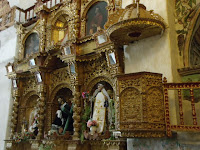
The inside of the church itself is relatively ornate in contrast to the outside, but still less so than so many other baroque churches in Peru.  It reflected a small town's best attempts, and evoked a prosperity long gone.

On each side of the nave there were effigies of saints, including a saint (Santa Ana?) in local attire and a 17th Century life-sized Christ the Nazarene.  There are also paintings of the Cusqueno school and plenty of gold leaf.

To the left of the altar, in a side nave, there were stored the andas, or litters, upon which the effigies are carried in procession through the town on their holy days.  Also kept there was rather detailed, life-sized effigy of the dead Jesus in a glass coffin, no doubt for the Easter Friday procession.


Being at the foot of the volcano and near a geological fault that transects the valley, the church of Maca has suffered damage throughout the centuries.  Fortunately it was declared a national treasure in 1980 and has been restored and maintained through funding provided by the Spanish crown.

Next to the church a couple of locals had trained eagles to stand upon tourists' arms, knees, shoulders, or heads. He requested a donation for letting one take pictures with the birds, and no doubt garnered far more that way than if he had requested a set amount.


The birds themselves were quite handsome and surprisingly heavy, as well as patient.

After a few minutes of this we reboarded the bus and continued our way back to Arequipa.

Saturday, May 7, 2011

Chala

On the way to  La Noche, Liz, Jason, Sara, Jacho, and I stopped for dinner at Chala, a restaurant at the top of Barranco's Bajada de Baños, the picturesque walkway that descends from the plaza to the seashore, where decades ago there had been a beach club, and a boardwalk and gazebo out over the ocean.


Chala, named after a small fishing port about halfway between Lima and Arequipa, labels itself as a "Coastal fusion" restaurant.    It's chef, Israel Laura, seems to be one of the few in Lima exploring Ferrán Adria-style "molecular" cuisine, playing with the coast/ocean theme by incorporating foams into the repertoire.   However, he manages to do so without the foams and mousses becoming the main element of the dishes in which they appear.

For example he accompanies tequeños -won-ton crisps surrounding a meat and cheese filling- with an ocopa foam which takes a commonplace, very familiar Peruvian sauce, and transforms it into something unexpected through the simple application of air.

Another instance of the judicious use of foam is the Tungurahua.  It is one of a selection of "Molecular cocktails" on the drinks menu and is named after one of Ecuador's most active volcanoes.   It is presented with a layer of a pisco and strawberry foam sitting magmalike under a layer of clear soda.   The red foam "erupts" through the soda upon mixing.

Another nifty dish, and a tasty one too, is the Chita en su nube.  "Chita" is a type of fish of the Anisotremus genus, a type known in English as scrod - yeah, I know, go figure.   The word "nube" means cloud, thus the name of the dish translates as a "chita fish in its cloud".  The "cloud" referred to is a puff of oak smoke held over the plate by a plastic dome.   When the dome is lifted a the table, the smoke escapes dramatically, leaving behind a pleasant woodsmoke smell which infuses the fish and its accompanying vegetables and sauce.


The menu is one the more inventive ones in Lima, and in emphasizing seafood, airiness, and by physically lightening up traditional dishes, offers a refreshing contrast to the Novo Andina fusions which often rely on thick Andean sauces.

Chala definitely merits a repeat visit.


Chala
Bajada de Baños 343
Barranco - Lima


La Noche


On the night before the wedding, a bunch of us went to the "artists" district of Barranco to catch a show at the La Noche club.   

This is the same club at which I saw Magaly Solier, Masacre, and Area 7 perform in August of last year.  Playing on this Thursday night was an old school mate of Carla's at the school in San Felipe, Lucho Quezquezana (known to old classmates as "Keke").   

Arriving a tad early, we found a table on the second floor balcony, ordered some water and a bottle of pisco, and settled down to chat and await the 11 o'clock show, which -in typical hora peruana (Peruvian time)- started promptly about 45 minutes late.

 
Quezquezana has made a longterm project of gathering musicians from diverse traditions and instruments and bringing them together to play Peruvian music and his own compositions, which draw heavily from jazz and Andean musical traditions. (I noticed that one of Quezquezana's percussionists was the same bald guy who was Solier's musical arranger and percussionist.)   On this night his ensemble was performing a set consisting of his latest album Kuntur ("condor" in Quechua).


The music was good, but I think that to really appreciate it one must be able to watch the musicians play the instruments and switch from one instrument to the next, particularly someone like Quezquezana, who himself plays over 20 wind, string, and percussion instruments.   Unfortunately, he is so popular that we were unable to consistently view the stage without craning our necks or staring between people's legs at the stage below us on the ground floor.

Conscious that we were to stay up late on the following evening, and that some of our group did have to work in the morning, we decided to call it a night around 2 a.m. and went home to get some sleep.

Sunday, August 8, 2010

Area 7 and Masacre

The night following the Magaly Solier concert, and my last full night in Lima, Jacho and I returned to La Noche, this time for something a bit different.   On Thursday night there were listed two acts of a more subte nature: Masacre and Area 7.


Masacre was the headline act.  I didn't remember this at the time, but Masacre is a metal band that has been around since the 1980s, and is a mainstay of Peru's metal scene along with bands such as Kranium.   Instead, I had half-expected a punkish-type concert.

Masacre is an accomplished band and is likeable enough, but truthfully I found some of their music to be pretty standard metal fare.  I was more impressed with the opening act, Area 7. 

Area 7, it turns out, is a band that was started in 1999 by lead singer Diana Foronda, as a metal cover band.  As the lineup changed, the band began to compose their own songs and evolved into an example of Peruvian "Nu Metal"  (i.e. 'new metal').  


 Area 7 stands out for being one of the few all-female Peruvian rock bands, and they're quite good at what they do, to boot.  They were a lot of fun to listen to.  I'm sure, however, -in fact I know- Jacho would disagree.

It was actually kind of an amusing scene.  We two forty-somethings posted at the end of the bar with an expensive bottle of pisco, surrounded by disheveled teens and twenty-somethings drinking beer out of 1-L plastic tumblers and whirling about the mosh pit.  Jacho's such a good sport for having gone with me!

Here's a video of Area 7 in action that I found on YouTube:


The quality on videos of them on Youtube generally is fairly poor, but good recordings can be listened to here. I specially like "Fuerte, Intenso".

From the stage Diana announced that they'll have an album coming out for download by the end of the month.  I look forward to getting it.

Magaly Solier


On Wednesday night Diego, Jacho and I went to Barranco to see Magaly Solier, who was appearing the La Noche nightclub.    We thought that she might just perform a few songs to prommote her album, Warmi, but were pleased to find that she performed basically the entire album, plus a couple of other songs, including a rendition of Ricardo Dolorier's "Flor de Retama" which was among the nicest Ive heard.

"Flor de Retama" was written about the brutal police repression of a popular strike for education in Huanta in 1969, but it regained popularity in the 1980s as an oblique protest against the police and military repression endured by the population of Ayacucho during the civil war.     Solier's own songs also reflect her experiences and those of the region's populace during the war years, expressed -in Warmi- through the voices of several female characters (warmi means "woman" in Quechua),  like those of "Citaray", who lost loved ones to political violence, and of "Maribel", the main character and a "young woman who dares to help other women who are determined to not let themselves be abused by their men".

All three of us were impressed with what a nice, simple person Solier seems.   She's famous, with a several movies out, a musical album, and her face on Nescafé adds all over the place, but she's still able to confess that she gets "very nervous" whenever she steps on stage to sing for an audience.  The audience was small, but the space was also small, which lent the event a bit of intimacy, and there were some people she knew among the audience and she seemed comforted and pleased by their presence.

Nonetheless, she didn't seem to let her nervousness affect her performance:

Magaly Solier performing 'Ripu Ripusajmi' at La Noche, August 4, 2010

All in all, we were very impressed and glad that we made the effort to go to the concert, and I made sure to buy the album the first chance I got (in fact I'm listening to it as I type).

Saturday, July 10, 2010

Barranco food festival

After a sleeping in after a boys-only night out with the cousins and uncles at an Argentine-style BBQ restaurant, followed by a late night of conversation and Scotch, Diego and I spent the morning cleaning house, followed by watching the World Cup soccer match and then lazing away the afternoon.

Come evening, however, I was itching to get out and play a bit, so we headed to the seaside bohemian neighborhood of Barranco, which is home to poets, artists, musicians, good restaurants, and fine examples of Republican architecture.


Tonight, however, we found that it was also home to a craft and gastronomic fair.   Diego and I settled ourselves on stools at one of the booths and whiled away the minutes with pisco sours while we waited for cousin Juancho to join us.


We were there so long, and had so many rounds, that the young woman tending the bar got kind of familiar with us and that led to some amusement.  A while later, after she had traded out with another bar tender, she came back to the booth to get something and when she saw us, she chuckled and exclaimed "You guys are still here?!"   Diego responded with some flirty comment and she mentioned that she had actually just switched booths to one around the corner.   As we didn't like the new bar tender's touch, we decided to relocate to her booth for another round as Juancho joined us.   The young woman brightened up when we approached, and Juancho remarqued that she seemed to know us, to which she replied that of course, as we were "loyal customers."   We finished the round, then walked around and found ourselves in need of a bathroom, what with six pisco sours apiece in our systems.  We found a restaurant that let us use theirs, and when the door to the bathroom opened up, who should emerge?   Our bartender, of course!  over which we all got a laugh, with Diego swearing -truthfully- that we had not, in fact, followed her there.

We then walked around  the plaza, checking out the fair, while we again waited , this time for Jose and his girlfriend, Carla, meet us.  

There were booths selling handicrafts from various places around the country, though nothing that one doesn't find nearly anywhere else here.    The regional food booths were more interesting and we sampled some manjar blanco, and Andean cheeses, of which I ended up buying a wheel.


When Jose and Carla arrived, we adjourned to the prepared foods section for a late dinner.


We ended up ordering a bunch of dishes from which we all sampled freely until we'd had  all we wanted -save Carla, who managed dessert- and there was naught left to do but take ourselves home.   Below is some of what we sampled:

Anticuchos, rachi, and choncholines:  grilled beef heart, tripe, and chitlins.

Tacu tacu montado:  Bean and rice patty with steak and egg.
(We got a double-yolked egg!)


Rocoto relleno:  Rocoto hot pepper stuffed with spiced beef and cheese.


Parrillada de cinco sabores:  five-flavored grill, meaning it includes five kinds of meat
- chicken, beef, pork,
pork sausage, and cabanossi.


Tallarin verde con milanesa de carne:  Pesto noodles with a breaded beef fillet.


Aji de gallina:  Shredded chicken in a spicy cheese and pepper sauce.
(This is one was a bit too salty.)