Showing posts with label Gluten-free. Show all posts

Sunday, August 3, 2025

Eating Gluten-Free in Lima, Peru


A few years back I did a post on dining gluten-free in Peru, particularly in Lima. (Read it HERE

Today, the same recommendations I made then still apply.   Happily, however, the situation is improving quite a bit. 

There is now a small chain of grocery stores, Flora y Fauna, that has many gluten-free offerings - breads, cereals, pastas, pastries, and other items.  Many of the products they carry are also dairy-free, organic, or vegan.


In general supermakets, it is now harder to find gluten-free items, even though they are still somewhat available, because most seem to have done away with dedicated gluten-free and "healthy" shelving, and just mixed those products into similar categories. 

The bigger food companies comply with EU labeling standards and so are pretty good at listing allergens and shared equipment. 

Previously I had stated that Braedt charcuterie was gluten-free, but I have inquired again and this time got the response that they could not assure that their products were gluten-free.  However, there is now a line of good quality charcuterie available in supermarkets from the Casa Europa brand which are almost all labeled as gluten-free.

Dining out has become a bit easier.  Servers and cooks seem more aware of allergens and are clearer on whether they can accommodate special needs.  Their suggestions aren't always the most creative, but they make an effort.

We did find two places that make gluten-free dining fairly easy.

One is Limaná restaurant, in San Isidro.  Almost all of their menu is gluten-free, including gyozas, desserts and pastries, and the staff is knowledgeable and very friendly.  We've dined there a few times, and had good meals every time.  The prices a bit high, specially for the portion size (compared to many other Peruvian eateries) but the ability to just relax and have multiple gluten-free offerings  makes up for that.


Some of the gluten-free offerings at Limaná

Another spot is Armónica Café in Miraflores.  Most of their menu is not gluten-free, but they have a selection of gluten-free pastries, including alfajores, truffles, cookies, brownies, and more, and good coffee to go with them.

Armónica Café
 

Armónica is located on Avenida La Mar, which is a center for dining, with many well-known restaurants nearby, so it is a good option for an after-meal coffee and dessert.

Speaking of which, Armónica Café is walking distance from Pescados Capitales, where one can not only enjoy good cebiches (all naturally gluten-free) and excellent pisco sours, but also, we have discovered, a tasty gluten-free dish of grilled paiche (also known as "arapaima" outside of Peru).  The dish is called "Lujuria" on the menu.


Another recent discovery is the Rinconcito de Tiabaya restaurant in Surquillo.   The place is set up as a traditional picantería and serves the cuisine of the southern region of Arequipa.  It is not a gluten-free space but it has many dishes that are gluten-free just because the ingredients are such.  These will be basically fried meat cuts accompanied with salad and potatoes, and few othe dishes as well.  We were assured that the fryer is dedicated and only meats go into it so there is no cross-contamination, and the staff were very attentive to our needs.


The ability to order a full meal (portions are big), enjoy tasty traditional foods, have multiple options, and not have to leave something off or do without some part of it was nice.  


Tuesday, June 26, 2018

Eating Gluten-Free in Lima

Well, tickets are bought for our next trip, which is coming up quite soon, and this time Liz will be able to join me in Lima.

That, of course, brings up the matter of traveling and dining gluten-free in Lima, and in Peru generally.

There are, of course, hundreds of dishes and thousands of foods that are naturally gluten-free in Peru. Everthing from amazing fruits and vegetables, to meats, seafood, and dairy. Same as everywhere else, but with the bonus that, as a traveler, one gets to enjoy things that one usually does not get to try. Prepared foods, however, are a whole different matter. 

In terms of gluten awareness, Lima is about where the US was, maybe, fifteen years go. The rest of the country, further back.  And, like in the US, it is often seen as an affectation by the middle class, in imitation of foreign food fads (which is not to say that that appreciation doesn't have a kernel of thruth to it).

Through the work of groups such as the Asociacion de Celiacos del Peru there is increasing awareness celiac disease in Peru, at least at the level of producers and retailers, such that most major supermarkets now have a small section dedicated to certified gluten-free products --mostly cookies, biscuits, and crackers of various sorts. Their website, celiacosperu.org, says it lists certified foodstuffs but the links do not work at this time (it does, however, offer a list of certified gluten-free medications available in Peru).  Further, and more current, information about foods and restaurants can be found at their Face Book page.

Prepared Foods

The larger food companies, that are subsidiaries of multinational corporations, follow the EU protocols for food labeling, including listing of allergens in the ingredients.  (I have not seen any mention of shared facility or shared equipment on labels.)  Smaller, local producers, are usually less strict.

Specifically, I have been told by the Braedt company that all their products --sausages, chorizo, and so on-- are gluten-free. Sometimes, retailers will buy large packs and split them up into smaller packages for sale.  If you are concerned by this, then make sure to buy Braedt products in their original packaging, or at the Braedthaus stores.
 
[Update: In July 2024 I inquired again, and a Braedt company rep responded that they could not give an assurance that their products are gluten-free.  However, almost all of Casa Europa's sausages and cured meats are labeled gluten-free.]

Likewise, the company that makes the popular Tarí hot sauce and the Alacena line of sauces and condiments has indicated that all their products in that line are gluten-free


Dishes to avoid

  • Ají: Not the hot peppers, but the sauce that is made from them and is found at almost every table. If you don't know how it was made, skip it, as a lot of recipes -specially for the creamy ones- contain crackers.  As noted earlier, packaged ají or rocoto pepper sauces from the Alacena or Tarí brands are ok.
  • Crema de rocoto: Same as above
  • Papa rellena: The potato balls are rolled in flour before frying.
  • Chicha de jora:  Andean corn beer, but oftentimes includes a measure of barley.  Producers usually don't list ingredients, so best to avoid it.
  • Emoliente:  A steaming hot herbal drink, which is great for the winter cold, but contains barley.
  • Ocopa:  The sauce contains crackers.
  • Papa a la huancaína:  Traditionally it is made from cheese, aji, salt, and a little oil, but these days chefs are likely to put in ground crackers for consistency and flavor. Ask before ordering.
  • Ají de gallina: Contains bread crumb as a thickener.
  • Lomo saltado:  Contains soy sauce and possibly oyster sauce.  However, you could ask them to make it without the sauces in a clean pan.
  • Pollo a la brasa: The ubiquitous rotisserie chicken.  In most places it is marinated in a mixture that contains soy sauce and/or beer.   For the original (and gluten-free) version made only with salt and fire, you must head out of town a bit to the Granja Azul.
  • Arroz con pollo or Arroz con pato: They are made with beer.
  • Seco de cabrito, Seco de carne, Seco a la norteña: Green-colored stew with a cilantro gravy. May be made with beer or chicha de jora.
  • Sudado:  A steamed fish or seafood stew. Likely to be made with chicha.  Ask before ordering.
  • Sopa patasca or patache: A soup from the Andes. Contains wheat kernels.
  • Jalea: The seafood is breaded or floured, and fried.

Bear in mind that, particularly outside of Lima, trigo (wheat) or cebada (barley) may have different names depending on the form they take. Some examples:
    • Pusra: coarse-ground barley.
    • Morón: coarse-ground toasted barley or wheat.
    • Salvado: bran.

Eating Out

As Peru experiences its culinary boom and more and more cooks come out of culinary schools rather than just home kitchens, it is easier to find restaurants that can and are willing to accommodate requests for gluten-free preparations. This is specially the case the higher one goes up on the price scale.

Here are some tips to make your ordering experience easier:

- Avoid the lunch rush. You'll get better service, a more attentive hearing from your server, and more care from your cooks, if they are not rushed or stressed. Particularly important if you are working across a language barrier.

- Don't go cheap.  Peru is a place with seemingly an eatery on every block. Most of those offer an inexpensive prix-fixe lunch, called the menu (if you want to read the menu, ask for the carta). The nature of these places is that they are meant to get workers on their lunch break in, fed, and out, quickly. The food is already fixed and they have neither the time nor the ability to handle special requests.  Better to go to a restaurant where the ordering is a la carte.

- Don't count on either your server nor the cooks knowing what the heck you are talking about. Most will never have heard of celiac disease (celiaquia), and as for gluten, the thinking is likely to be "I don't know what that is, but know I didn't put any of that in there."  It is better to be as specific as you can as to what foods you need to avoid and which you can eat.

- Give your server and cook something to help them remember what you need.  Liz and I came up with this card a few years ago to present to waiters,

 
 It says,

I have a disease called celiac disease and I must follow a rigorous gluten-free diet.

I could get very ill should I ingest foods that contain grains or flour from wheat, barley, rye, or oats, or that contain ingredients made with wheat, barley, rye or oats (for example: soy sauce, beer, bread, cookie, various sauces).

I can eat rice, yuca, potatoes, sweet potatoes, beans, meats, eggs, fish and shellfish, fruits, vegetables of all kinds, as long as they are not prepared with ingredients that contain gluten or are prepared on the same surface or with utensils shared with foods with gluten. If in doubts, please use freshly-washed utensils.

Thank you for your help.

More information about celiac disease at http://celiacosperu.org


The card has helped a lot, and staff have always been appreciative. In some instances waiters or the kitchen staff asked to hold on to it for reference. Feel free to copy it.


Saturday, July 11, 2015

Lunch at Ámaz restaurant

Last week, just before Liz headed back to the US, we took ourselves out for lunch in Miraflores.  Wanting something a bit special and something on the lighter side, Liz picked ámaZ as our spot. 


We found, by the way, that Monday afternoon is not a bad time to go out, as we were able to be seated immediately without having a reservation.

ámaZ offers appetizers, but also offers many of its dishes in half-portions, so we opted for sharing a mix of dishes.  We have both enjoyed ámaZ's fare in the past, so we knew that we would not be disappointed.  Additionally, we knew from the menu and the attention to detail that there would not be a problem accomodating Liz's dietary restrictions (no gluten).  As it turns out, at ámaZ no grain flours are used, and only a few of the dishes contain soy sauce or hoisin, so almost the entire menu was wide open to us!

Cebiche ámaZ - made with fish and bananas

Los maduros de Doña Eli - plantain cups, with onion and smoked pork relish.
These were so good that after ordering a half portion, we ordered this full portion as well.

Avispa juane - rice and pork, cooked in  bijao leaves

Seafood and vegetable sautee

Charapa hot peppers and cocona fruit salsa

Helado de cecina - ice cream flavored with smoked peccary meat, with a dark beer reduction, Maras salt, and a sapote granita

Jungle fruit sorbets - capirrosa (pink), cocona (yellow), and copoazu (white).
The copoazu sorbet was a revelation.  Being related to cacao, its sorbet did have a hint of chocolate flavour at the very end of each mouthful, but to get to it one had to traverse a mix of sweet, not-so-sweet, paint, and other oddly familiar -but none unpleasant- flavours.  It was weird, but good, and so much of both that one wanted just a bit more, and just a bit more...

It was a great last lunch together before our few weeks apart, and the fare being so flavourful but light, neither of us was too full to walk for a bit.

We headed toward Parque Kennedy, where we had some coffee at an outdoor cafe before heading home.


Tuesday, June 30, 2015

Lunch at Central


Last week, Liz and I had the opportunity to lunch at Central restaurant, here in Lima's Miraflores district.

Central has been one of the up-and-coming star restaurants on the Lima food scene, and we had been curious about it for some time as it kept getting consistently good reviews.   It also happened that at about the time we made our reservation a month ago, Central was ranked in fourth place among the world's 50 best restaurants on the 2015 edition of the prestigious San Pellegrino World's 50 Best list, and No.1 among Latin America's 50 Best Restaurants. 

Liz and I opted for experiencing what Central has become best known for, which is their 17-course Mater Alturas tasting menu.

The ingredients for each course of the Mater Alturas menu (as well as of the smaller Mater Ecosistemas menu) are sourced at specific elevations in Peru, ranging from 70 feet under the sea to almost 14,000 feet up in the Andes. Those ingredients are put together in ways that don't resemble any typical Peruvian foods, but are innovative and, actually, quite tasty ... and beautiful.

Here are some of them, in no particular order:


Seafood crisp with seafood cream and seaweed.

Corn several ways (and in several varieties): paste, crisp, and soup.

Cauliflower with crisps and flowers.


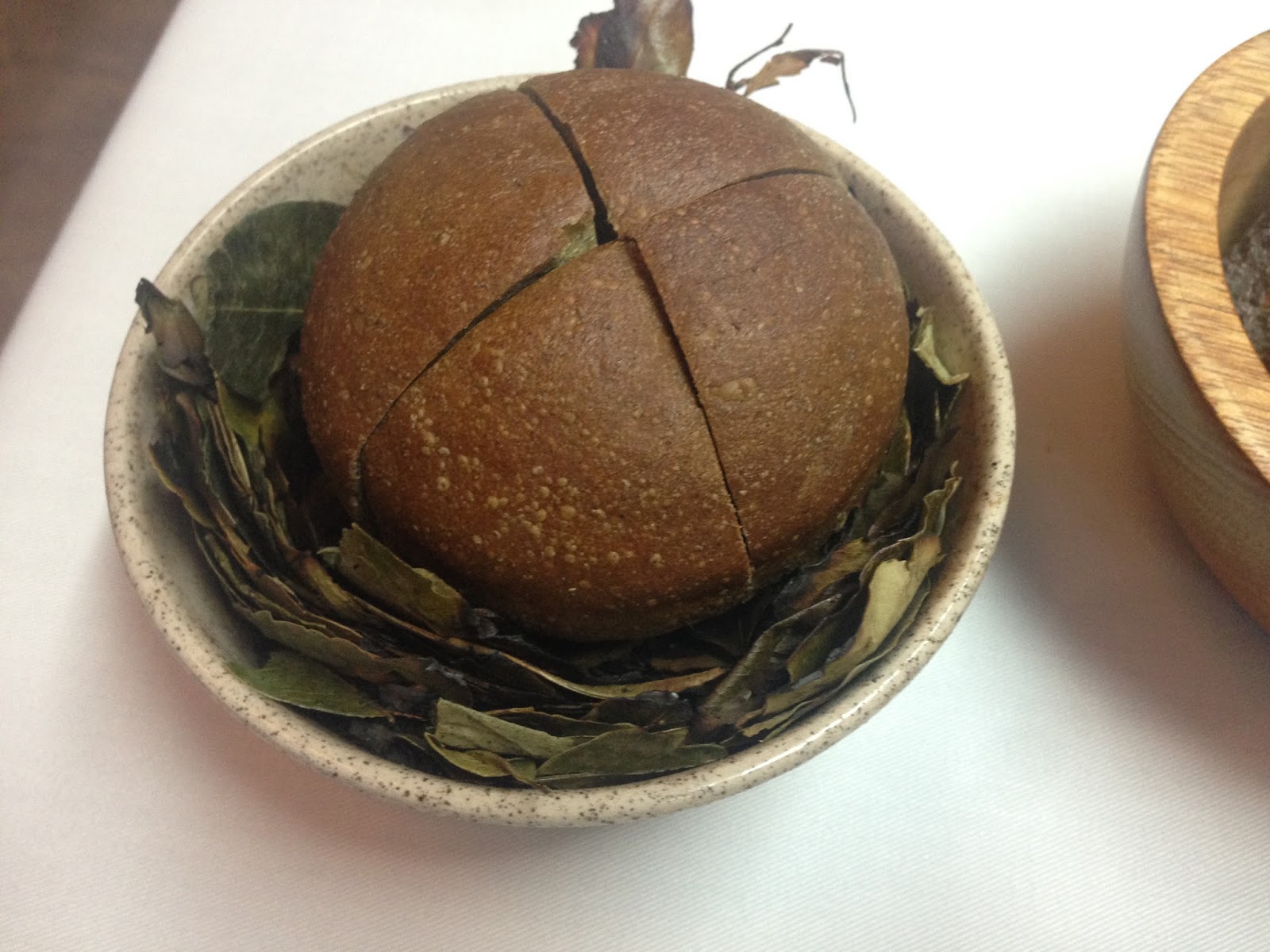
Herb bread served over smoking coca leaves.

Razor clams with pepino melon and citrus.


Ayrampo and pommegranate extract.

Doncella (an Amazonian fish) with nut cream and jungle fruit.


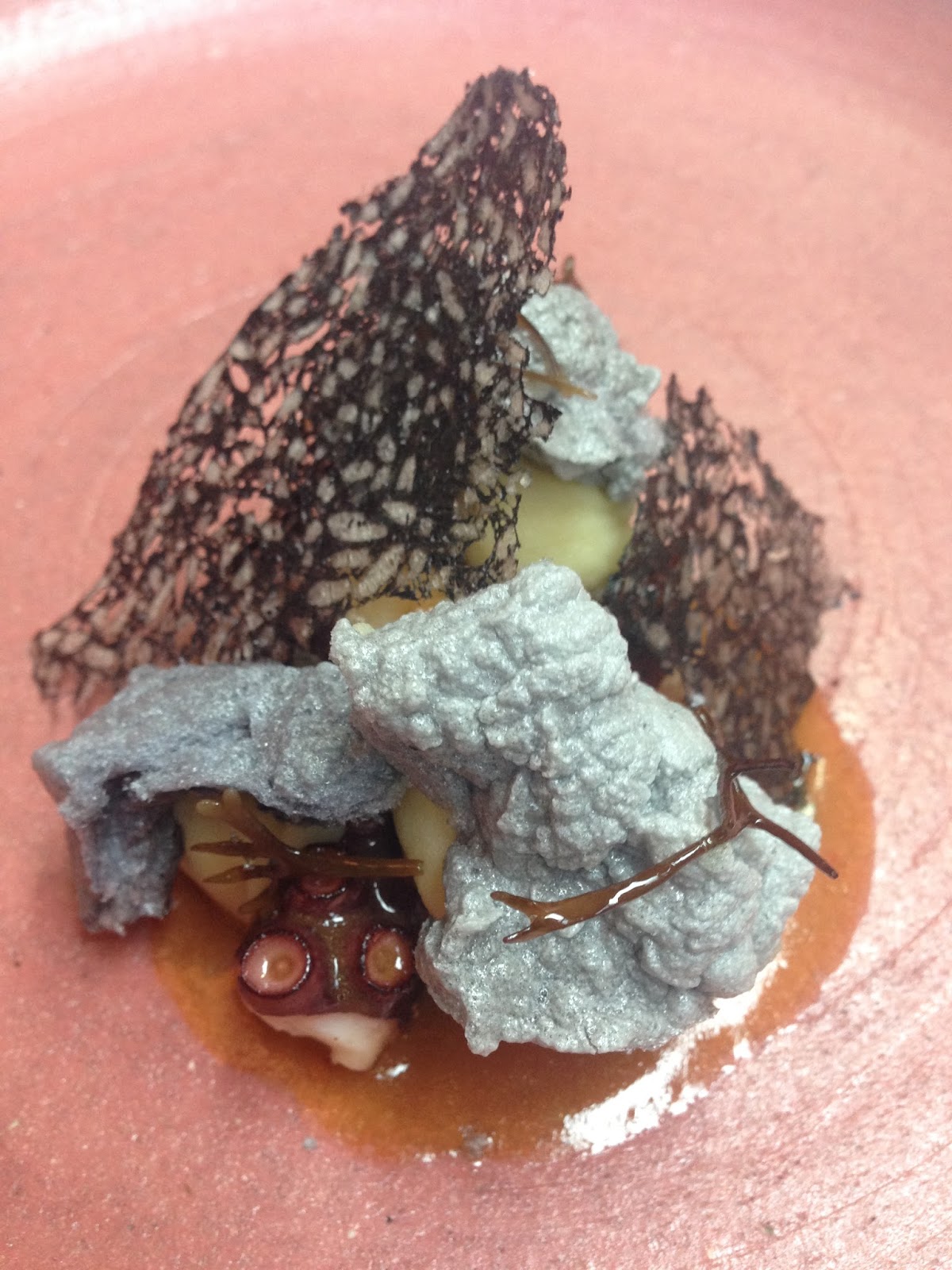
Octopus, sea snail, and octopus ink foam.
An intense octopus broth.


Calf steak covered in quinua colored with herbs and cactus, with an Andean herb-infused cream.


Chocolate ice cream with flakes of lucuma and chaco, an edible clay.

Fruit sorbet, with ayrampo-tinted fruits chunks.

Cacao fruit extract in reverse-osmosis water, with kiwicha jellies.


Chicken with a hollandaise sauce and moraya pearls and cushuro.  Moraya is an Andean tuber and cushuro is a sort of cyanobacterial colony that forms small green balls in the wet ground around high Andean lakes.


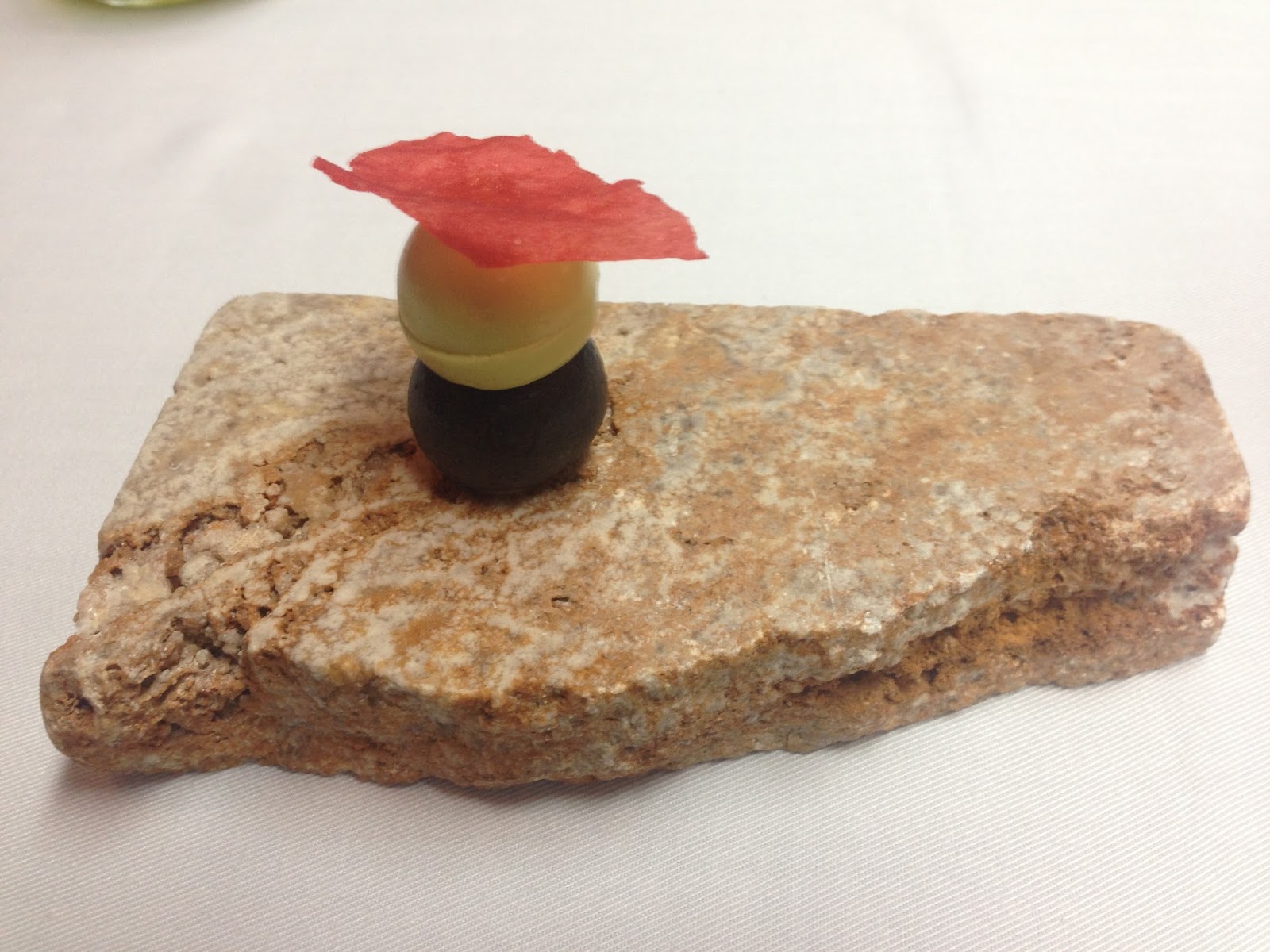
From top to bottom: ayrampo crisp, avocado cream, algarrobina cream.

Besides the quality and innovation in the preparations, one detail that was impressive was that in many instances it wasn't just the dishes for one course that hit our table but actually the regular dish and one or more glutten-free or dairy-free dishes for Liz whenever the regular dish contained gluten or dairy.  In effect, we were each served a similar but still different 17-course menu!


Central
Santa Isabel 376
Miraflores, Lima
Peru
centralrestaurante.com.pe