Showing posts with label Sierra. Show all posts

Friday, July 18, 2014

A Few Photos From Along Ayacucho's Main Plaza

The Plaza


Ayacucho's main plaza


Equestrian statue of Gen. Antonio Jose de Sucre, one of Bolivar's lieutenants, who led the Independentist forces to victory over the last remnant of the Spanish colonial army at the Battle of Ayacucho.


Most of the plaza was built in the late 1500s and 1600s and all the buildings are in the Spanish style of the time.  There is one detail, however, that passes unnoticed even by people who've grown up in Ayacucho:

Portion of a wall  in Portal Independencia, along the north side of the plaza, showing that at least one Inca mason was used in erecting the original building along the plaza.  Note the close, mortarless fit between stones, and that the face of the each stone bulges out, and recedes toward the joining edges.


The Cathedral 


Ayacucho cathedral, erected in the 1600s and consecrated in 1671.  To it's right is the Zamora y Castilla mansion, which once belonged to Bishop Cristobal de Castilla y Zamora, who donated it to the newly-created University of Huamanga in 1677.


Central nave and the Baroque main altar of the Cathedral.

 Baroque wooden pulpit.

Detail of one of the chapels along the side naves of the cathedral.  In this case, the depiction is of the Holy Trinity.

The main altar.

Litter bearing the image of Our Lady of Mt Carmel, ready to be borne in procession in the upcoming Fiesta de la Virgen del Carmen (July 16th).

The University House


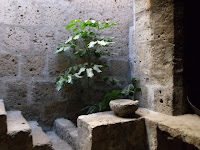
Patio of the Zamora y Castilla mansion.   According to some authorities, that fig tree is 500 years old and is the first one to have been brought to Peru.


Saturday, July 12, 2014

A Few Pictures of the Old Family Home in Ayacucho


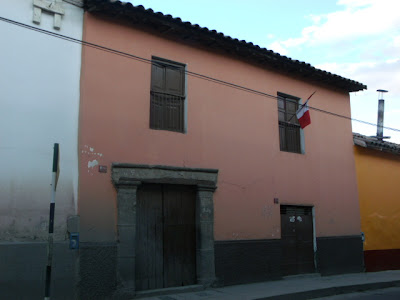
The view down the street, on Av. Garcilazo de la Vega.  The peach-colored building used to be a police station, and during the Shining Path attack on the city jail in March 1982 guerrilla snipers took over the rooftops on the near side of the street in order to prevent the officers from sallying in support of their comrades at the jail, five blocks down the street.

The view out back.  The large building used to be the Cavero family's cinema.  Every afternoon on my summer visits to Ayacucho was marked by the sound of the cinema's generator going on for the day's showings.  Today it is an evangelical church, but they have kept the projector on display in what used to be the lobby.

The main part of the house, likely built in the 1700s, viewed from the entrance to the courtyard. My great aunt Esther had a parrot, named Pepinillo Landaeta (or Pepe, for short), who lived on the ledge on that nearest column.

A partial view of the house's courtyard and balcony.  The door at the end of the balcony used to be my great aunt Esther's room, and to its right, behind that shuttered window, was the parlor.

Thursday, July 10, 2014

Back in Ayacucho


I'm in Ayacucho, having arrived yesterday for a two-evening colloquium on "Class, Gender, and Building of Peace in Peru".

I'm staying at the rather pleasant ViaVia Hotel, right the main square.


The hotel is located in Colonial  mansion that has been fixed up with funds from Belgium and is run by the ViaVia traveller's cafe and hotel chain  - they even have Belgian beers on sale in the restaurant.

Normally, I'd stay at the family home on Garcilazo de la Vega street, two block from here, but it's never that comfortable -despite being free- so I opted for the hotel and hot showers on demand.

Not much sooner than I had arrived than the power went out and remained out through lunchtime and on into the late evening.

That meant that I missed all of the Argentina-Holland soccer game in the World Cup except for the addiional time added on because they were tied at the end of egulation time.

The game went to penalty kicks, which I had to miss as otherwise I'd have been late to the colloquium. Fortunately, like sio many others, I could keep up with the progress at any shop doorway and window!


Thursday, July 3, 2014

Antioquia

Continuing on our road trip up the Lurín valley from Cieneguilla, we headed into Huarochirí province and to the town of Espíritu Santo de Antioquía, more commonly known as just Antioquía.

Antioquia's main square


Antioquia city hall
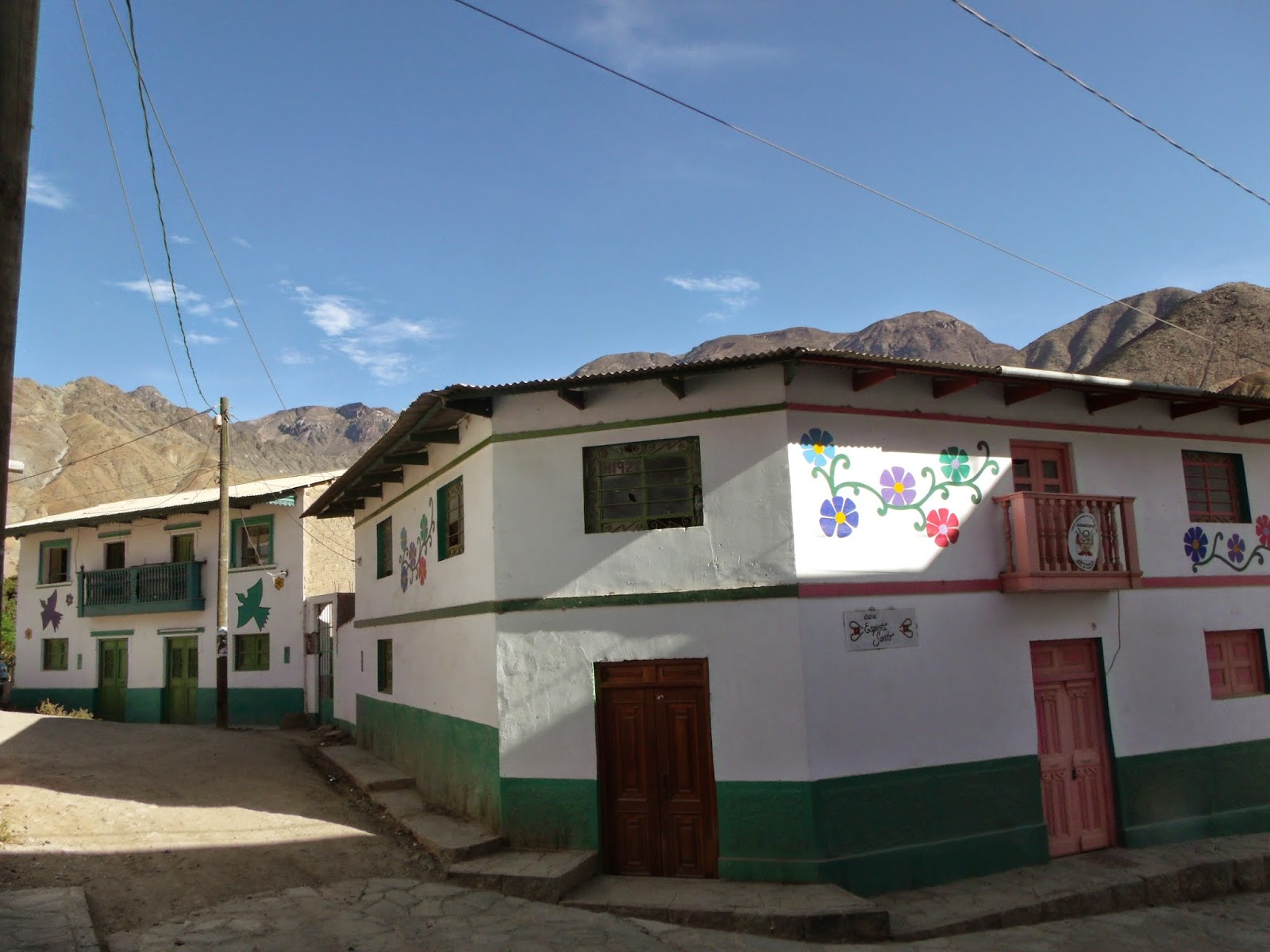
Antioquía's claim to fame is recent, and due to the townfolk's practice of decorating their homes with images drawn from nature - birds, plants, flowers.  The paintings, done in a naïf style, were the idea of a priest assigned to the town, who convinced the locals a few years ago to buy into the idea as a means of building town pride and pulling in a bit of the valley's tourist trade.  

Elba, Willy, and Liz in front of Antioquia's church

It must be admitted that the idea has on fact worked.  We, for example, were the third delegation from our family to make the trip to the town in the past several months, and we had all learned about it from it's being featured in newspaper, magazine, and television segments.


The road to Antioquía is still a bit rough, but even so there's enough traffic to allow a couple of restaurants with large seating to operate in town.   I expect that once the road is paved the whole way, it won't be long before a good segment of Cieneguilla's weekend tourist traffic will head that way, even though it is about an hour further, much as the summer beach exodus has moved ever further out of the city in the past decade.

u

Thursday, August 2, 2012

Ayacucho, Day 2

On our second day in Ayacucho (the 28th of July), I got up early and went down to the corner, to the park in front of San Francisco de Paula church -one of the city's 33 colonial-era churches- and watched people mingle after a wedding and perhaps some baptisms.


The fountain, which has not worked in anyone's memory, was at one time a favourite plaything for my cousins, siblings, and I, who would climb it, hang from it, and clamber into it like a bunch of monkeys.  (Somewhere, there's a photo of us in it.)

 Susa soon awoke as well, and we ventured down to the plaza for breakfast at the Restaurant Via-Via, in what was once the Hotel Sucre and is now a Belgian-run hotel with the same name as the restaurant.


The food and service at Via-Via are quite good -always cheerful and prompt- and the view from the veranda is great.  In the image above, across the Plaza de Armas, one can see the cathedral (consecrated in 1672).  Immediately to its right is the palace of Diego Ladron de Guevara (built in 1677), which has long been used as the seat of the University of San Cristobal of Huamanga, and to its left, is City Hall.


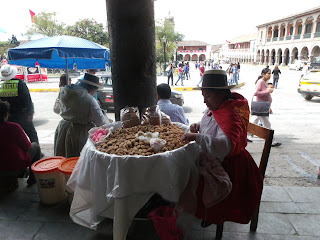
Dowstairs, under the archways one can always find ladies dressed in traditional Huamanguina outfits selling old-fashioned treats: cookies and sweet breads, or hand-made icecream.


After walking around downtown for a bit, and sitting in the plaza just people-watching, we wound our way back down to the Alameda for lunch, after which we headed back to the house for a nap and some reading.

In the evening, we went to Lalo's Cafe, a cafe owned by friends of Sara's, at the Centro Cultural San Cristobal, in whose courtyard we afterward watched a presentation of traditional dances from Ayacucho and other regions.

Wednesday, August 1, 2012

Ayacucho, Day 1: Gastronomic Festival

On the first day, after Susana had had a nap and I had gone to breakfast with Pocho, my aunt Betty's brother, Susana and I decided to have lunch at the gastronomic festival that we'd seen advertised all over downtown.


So, after walking down Jiron 28 de Julio, past the market, and then down past the long side wall of the nunnery of Santa Teresa, which still houses a small community of cloistered Carmelite nuns, we arrived at the Alameda, where the festival was being held.


The Alameda is a pedestrian walk along the Alameda River, bookended by archways.   It used to be mostly dirt with some trees, and a set of old swings and one of those spinny things that one pushes, running alongside and then jumping on, and which will send a kid flying off into the dirt if he doesn't hold on while it's spinning.  They were great.  The swings were so tall that they gave the impression that they were swinging one out over the 30 foot drop to the stony river bed on the other side of the low wall edging the Alameda.
Now, those are gone, and the area has been paved and landscaped with grass and flowers, and a fountain or two.   It actually is quite pleasant, if not as exciting for kids as it used to be.


Anyway, the festival was a great success.  There were many stands offering a nice sampling of Ayacuchano foods, and lots of people -both Ayacuchanos and visitors- enjoying the offerings.  (We, in fact, ate there on two consecutive days.)

Chicharrones with potatoes

Chorizo ayacuchano

Triplete of puka picante, chicharrones, spaghetti, beet salad, rice, and teqte

Afterward, we got corraled by a friend of Pocho's who was a few drinks to the wind who insisted that we join him in his orchard for a few beers, and thus we spent our first afternoon in Huamanga.


Back in Ayacucho


In the predawn hours of the 27th, Susana and I flew to Ayacucho for the Independence Day weekend.  Jacho and Diego had been supposed to join us, but they stalled on getting tickets and the prices of them at the last minute, plus the fact that this year it wasn't a 3-day weekend, finally dissuaded them.


We stayed, of course, in the old family 18th Century house on Jiron Garcilazo de la Vega, a block and half from the Plaza de Armas in Huamanga.


We found the house in pretty good shape.  The front had been re-plastered and repainted a few years ago, and the roof tiles had been repositioned to close up some gaps that had developed, while the ceilings had also been repainted to repair the spotting caused by the leaks in the roof.


The only issue of note was that the floor of the upper room, which used to be Mama Pali and Papa Ramon's, was cracked and slightly buckled, as a result - I was told- of the 2007 earthquake.


Over the next few days, I'll be posting more about our time in Ayacucho.

Wednesday, June 20, 2012

Video: Takanakuy

Another one. This time it's about the custom of takanakuy.

In the province of Chumbivilcas, in the Cuzco region, Christmas is celebrated with partying, drinking, fireworks -like in the rest of Peru.  What makes chumbivilcano Christmas different is the takanakuy, which is a festival of ritualized hand-to-hand combat. 

Fights are one-on-one bareknuckled fistfights accompanied by huaylia music, and all strata in the community take part -men, women, young, and old.  Even kids.  Through  the takanakuy grudges are settles, stress is released, community harmony is retained, and the Earth is repaid for her bounty through  the fighters' sacrifice.

In this video, the host, Thomas, travels to Chumbivilcas to witness and participate in the takanakuy.


PART ONE:


PART TWO:


Monday, June 18, 2012

Video: Scissor dance in Andamarca

Just browsing the web today I came across this cool little video on danza de tijeras, or scissor dancing, in Peru.  The danza de tijeras is an age-old custom, as one of the musicians in the video explains, and is intimately tied to Andean veneration of the earth and the apus and wamanis (mountain spirits).

The video shows two travellers -Krishna and Anthony- who drive  from Nazca to the community of Andamarca, in Apurimac, to witness a tijeras competition.      It reminded me of stories my mom told when I was little, of danzaqs she had seen in her travels, who -she said- seemed as if they had no bones in their bodies.

I've got to tell you that what the show's hosts witness the danzaqs do in Andamarca is a far cry from the tijeras dances you'd see on stage at folkloric shows in Lima.

Sunday, October 16, 2011

Convent of Santa Catalina de Siena de Arequipa


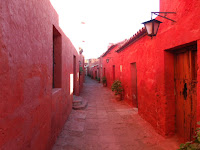
One of the main attractions in Arequipa is the old Convent of Santa Catalina de Siena. Santa Catalina was built in the 16th century to accomodate the desire of the townsfolk of Arequipa for a convent in their city.  Informed of thi wish during a visit, Viceroy Toledo, granted the necessary licenses for the establishment of a Dominican convent.  A few years later, a young widow, Maria de Guzman, decided to take the vows and enter the nunnery, and in 1580 the convent was formally inaugurated and Maria named "the first inhabitant and prioress of said Monastery."

For four centuries, Santa Catalina was community closed off from the rest of the world, enveloped in a mantle of silence and mystery, which contributed to both idealized imagining of life behind its walls and to lurid rumours.  Pehaps each had some measure of truth.  Santa Catalina, it is true, was a female-run world that lived by its own rules, laws and customs, dedicated to prayer and religious duty.  On the other hand, many of the nuns came from wealthy families and sought to preserve their status and comforts within the convent's walls, bringing servants with them, building -or buying- large personal "cells" with sitting rooms, private kitchens, and running water, and continuing to wear jewelry and gold.  One prioress, who tried to curb these practices, was the object of three separate poisoning attempts during her tenure!
At its peak the convent housed some 400 women, about 180 of them being nuns, and the rest servants, slaves, young women boarded there for their education, and women who had been given asylum by the order.  In the 1870s by order of the Pope, the servants and slaves were released, being given the choice of remaining and taking religious vows, or leaving the convent altogether. 

Several dozen Dominican nuns still occupy  a closed portion of the convent.  However, earthquake damage in the 1960s led the nuns to construct new quarters at the north end of the convent, fitted now with electricity and running water -in accordance with municipal regulations- and the majority of the convent was largely restored to what it looked like in days past (although most of the upper stories and roof accesses are now long gone) and opened to public tours in 1970.

I have to honestly say that the convent was one of the more memorable places we visited.  It is utterly fascinating to imagine the world that its walls must have encompassed, one little changed in the course of the centuries.  A veritable city within the city, the 5 acre convent has streets, plazas, fountains, a cemetery, and districts as any town would, as well as a hospital ward, a laundry, and a communal kitchen. The frequent need for repairs has made Santa Catalina a veritable catalogue of Arequipeno architectural styles through time. I think we took more pictures there than at any other single site