I hurt my knee last week so I've not done much. It was just yesterday that I've started to go out to places other than relatives' homes, and my cousin's medical practice.
My big adventure for the day was to get dropped off at the Lima International Book Fair after lunch at Toti and Marina's.
Normally, I hit the book fair a couple of times and can easily spend a couple of hours there on each visit. This time, however, owing to my knee issues, I zipped through only stopping at a handful of stands, most of which I had already decided on visiting anyway. In fact, I only delved in depth into two of them --those of the Istituto de Estudios Peruanos and of the Instituto Frances de Estudios Andinos-- and I only bought books at IEP's.
Showing posts with label Books. Show all posts
Wednesday, July 22, 2015
Monday, August 5, 2013
Lima Book Fair
On the Saturday after my birthday party and just before I returned to the US, I made it to the Lima Book Fair, which this year was in its 18th installment.
When Jacho and I arrived there was a big line to get in. We were impressed that so many people, specially young people, were so eager to get in, particularly given that it was only the second day of the fair and there was yet another fortnight in which to visit it. It turned out, however, that there was talk being given by Peruvian rock singer Pedro Suarez Vertiz at the presentation of his book, Yo, Pedro, which occasioned the long lines outside and, again, inside the tent!
Unlike other times, when I would scour the fair from end to end, and return on multiple occasions, this time around -due to matters of space and luggage weight- I went only the one time and targeted my shopping toward a few key stands and a predetermined wish-list of books I had been holding off on buying until the fair.
Among them:
- Memorias de un soldado desconocido by Lurgio Gavilan
- Historia de la corrupcion en el Peru by Alfonzo Quiroz
- Los Quipucamayos by Frank Salomon
I was also pleased to be able to pick up a copy of Sombras del Imperio: La nobleza indigena del Cuzco, 1750-1825, a translation of Shadows of Empire: The Indian Nobility of Cusco, 1750-1825, a book by Reed College professor David T. Garrett, whom I had heard speak on the subject at a talk at the Alianza Francesa a few weeks earlier.
Thursday, July 11, 2013
Jiron Quilca
This afternoon I headed back downtown, again to Jiron Quilca.
Quilca is a street that stands out in several ways. One that is not very obvious from the ground -although it could become evident with a bit of thought- is that it does not conform to the grid pattern of downtown Lima, but rather comes off of Plaza San Martin at an agle.
In the photo below, Jiron Quilca can be appreciated in the foreground, approaching the plaza at an angle rather at odds with the regularity of the surrounding streets.
Quilca is a street that stands out in several ways. One that is not very obvious from the ground -although it could become evident with a bit of thought- is that it does not conform to the grid pattern of downtown Lima, but rather comes off of Plaza San Martin at an agle.
In the photo below, Jiron Quilca can be appreciated in the foreground, approaching the plaza at an angle rather at odds with the regularity of the surrounding streets.
![]() |
| Photo: skyscrapercity.com |
When Francisco Pizarro traced the layout for dowtown Lima, he followed the "damero" (checkerboard) pattern of manzanas (city blocks) separated by streets criss-crossing at right angles. This pattern is repeated throughout Spanish America and is the reason that the core of downtown is sometimes referred to as the Damero de Pizarro. Quilca, however, notably breaks that pattern, appearing almost as a gash in the city in the image above.
The story is that Quilca follows the path of an Inca road into the city, and that at the triangular plaza at the what is today the intersection of Quilca and Av. Garcilazo de la Vega (aka Av. Wilson) there was once a tambo, or Inca way station.
Quilca is also noted as a center of Lima's bohemian life. For one thing, the stretch immediately contiguous to Plaza San Martin is lined with dive restaurants that come alive with at nightfall and spend the days sleepily puttering along, smelling of stale beer.
Quilca is, more meritoriously, also home to the Queirolo tavern, which was established in 1920 by relatives of the Queirolo wine and pisco-making family that owns the Santiago Queirolo distillery and Antigua Taberna Queirolo in Pueblo Libre.
The Queirolo, with its unchanged decor, is counted as one of Lima's classic bars and old-school eateries, and it fills up at lunch and in the evenings.
Quilca is also a locus of a more modern, youthful bohemian crowd, which tends toward the metal and punk "underground" scene. Much of which is centered -spiritually, if no longer physically- on the El Averno cultural center.
The center, which housed gigs and promoted the arts in general, was a vibrant presence in Lima's "alternative" scene for more than a decade, but also a constant object of police interest, who regarded it as a locus of "delinquency", and as attracting "bad elements" and "pot smokers" (OK, so maybe that last one was true! LOL). But, maybe even more than that, it was the fear instilled in institutional and bureaucratic conservatism by what is new, free, and transgressive.
The center was raided it on a number of occasions, with the cops -and on two occasions, hired thugs- tearing the doors out of their frames, looting the place, and sometimes violently attacking the young people they found inside.
El Averno shut its doors for perhaps the last time last October, after losing an appeal against a municipal eviction order, but its building remains, vibrantly and wonderfully defiant.
And even though El Averno is closed, Quilca's punk and metal scene has hardly faded away, as tucked away among the many used bookstores that line the street, there are small shops selling CDs, DVDs, fanzines, and anarchist newspapers, and which serve as clearinghouses -as do the very walls of Quilca's buildings- of information on concerts and new releases.
Tuesday, July 9, 2013
Book shopping
Yesterday, since Liz had left for the US and I suddenly found myself without anything in particular to do, I decided to do some book shopping.
My first appointed task was to walk to the offices of the Peruvian Forensic Anthropology Team (EPAF) to buy a book of theirs on damage left on skeletal remains as a result of human rights violations. I walked a number of blocks, made a wrong turn and found I was going the long way around -adding three more blocks to my walk- only to not be able to find the place. I walked back home and found that, whereas Google Maps had sent me to the tenth block of the street, the place I was looking for was on the third block!
After lunch, I caught a cab to downtown, and went looking for a political bookstore I had heard mentioned online. I did find the place, but no one there knew of the bookstore. I knew I was in the right place because it was an old building that housed the offices of one of Peru's Communist Parties, Patria Roja, and of the movement that arose from the recent anti-mining struggles in Cajamarca, the Movimiento de Afirmacion Social, led by Gregorio Santos. The shop must've closed last year at some point, is my guess.
So, frustrated for the second time, I walked from Avenida Abancay to Plaza San Martin, to visit one of my favorite used book shops in Lima, the Libreria Georges Politzer, on Jiron Quilca.
There, I did manage to pick up an interesting set of bulletins published by the Chinese Embassy in 1974-1976 containing news summaries from the Xinghua News Agency. I did not know that they put out such things, so I was rather pleased to find them -and to get the stack for just under 4 bucks!
Labels:
Books,
Lima,
News Media,
Politics and Government,
Shopping
Monday, August 1, 2011
Lima Book Fair
Last night, after resting up a bit after our return yesterday afternoon from our trip to Arequipa (more on that later), Liz and I walked to the Lima International Book Fair. The fair -which this year is in its 16th yearly "edition"- has been held for the past couple of years in the Los Proceres park (also known by its old name of Mata Mula) here in Jesus Maria.
As always, the book fair was a great draw, pulling in enough booksellers and publishers to fill almost 140 stands, including representations from Venezuela, Argentina, Ecuador, Turkey, and China. Even late on a Sunday night it was packed with people and the line of parked cars stretched for a couple blocks from the event site.
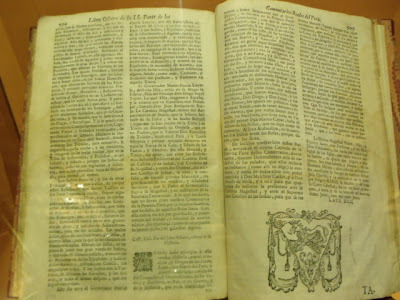
I got some nice books there, but I am most pleased with a facsimile edition of Garcilazo de la Vega's 1609 treatise, Primera Parte de los Comentarios Reales, que tratan del origen de los Yncas, reyes que fueron del Peru, de su idolatria, leyes, y govierno en paz y en guerra: de sus vidas y conquistas, y de todo lo que fue aquel Imperio y su Republica, antes que los Españoles passaran a el. That book, known in English as the Royal Commentaries, was a landmark history and description of Inca Peru as it was the first written by a descendant of the subject of the book - Garcilazo was descendant of Inca emperor Tupac Yupanqui. Lima's Universidad del Pacifico decided to mark it's 40th year of publishing by printing the full-size facsimile edition of the book.
| An original copy of the Comentarios Reales displayed in Garcilazo's childhood home in Cusco |
On the way home Liz and I mused about the success of the book fair, which draws people in droves, day after day over almost two weeks, and hat makes such an event possible here, as contrasted to the USA where book fairs are smaller and shorter events, with far fewer publishers represented.
Friday, July 30, 2010
Book Fair finds
Yesterday, after lunch I made time to head to the 15th Lima International Book Fair which is being held at a park near San Felipe, Parque de los Proceres -which everyone still calls Matamula, even though it's name was officially changed in the early 1970s.
Aside from a book on early photography in Ayacucho and one on the events in Bagua last June, I was rather pleased to find some older books which can be rather hard to find in Spanish, including a translation of Capital that was previously unknown to me.
Particularly pleasing was the opportunity to pick up a copy of the bookbound edition of Rafo León's Caín y Abel.
Caín y Abel originally appeared as a series of vignettes in the monthly No! supplement to Lima's Sí magazine in 1987. The storyline was told from the viewpoints of two twin brothers, Caín and Abel.
Caín was a rebel, part of Lima's "underground" (subterraneo or subte) music scene, and something of a black sheep. His contributions were punctuated with swear words and lyrics. Abel, on the other hand, was a sweet, studious boy, who wanted nothing more than to please his mother, and who's sanctimoniousness drove Caín crazy and made his father worry for his sexual orientation. The humor lay in the disparate ways that each described the very same events and the way that León was able to so fully convey each of his character's idyosincratic world-views.
Subscribe to:
Posts (Atom)