Friday, August 12, 2011

More on Arequipa

As I mentioned in an earlier post, Arequipa is in the southern Peruvian Andes, at an altitude of 7661 ft (2335 m) above sea level.  It is Peru's second largest city and a hub of political and economic life in the south of the country.  

Plaza de Armas

In the past, Arequipa competed with Lima for clout as Arequipeños resisted the centralization of economic and political life in the capital.    Though Arequipa is a friendly, welcoming city, arequipeños are a proud lot and not given to suffer indignities lightly.  Over the years they have even staged a number of uprisings and rebellions against limeño authority.  In fact, in the airport and in souvenir shops around town one can buy a "passport" from the "Independent Republic of Arequipa" - offered with tongue very-much-in-cheek, of course.  Today, Arequipa is currently one of the fastest-growing cities in the country and, as trade with Chile and smuggling into Bolivia have increased, its economic clout is once again on the rise.


The city of Arequipa -which is the capital of the department of the same name- lies at the foot of Misti volcano, and is flanked on the north by Chachani volcano, and on the south by Pichu Pichu volcano.  A bit to the north lie a number of other volcanoes -Ampato, Sabancaya, Coropuna, etc..  Some of them -including Misti- remain active though -mostly- quiet.

Misti volcano

Being in a volcanic zone, it is not surprising that Arequipa is prone to earthquakes, having been almost utterly destroyed in 1582 and, again, in the 1780s.   More recently, it experienced strong quakes in the 1950s and in 2001 a quake with a 7+ rating on the Richter scale severely damaged the cathedral and hundreds of homes and historical buildings.


While there, I remembered my mom having mentioned that one thing she found charming about Arequipa was that, with a dose of great common sense, the stones of the Plaza de Armas' archways had all been numbered so they could be more easily put back in place after being brought down by quakes.


I looked up and, sure enough, there were the numbers!


Of course, all that the volcanoes bring is not just woe.   Not only do they add beauty to the landscape and water from their snow packs, but they have also literally provided arequipenos with the building blocks for their city.

For centuries, arequipenos have been using sillar, a local white volcanic stone, as building material.   Sillar has become a signature of the city, and has given Arequipa its nickname of the "White City".


Arequipa's cathedral


Visiting Arequipa it was easy to see why so many consider it their favorite city in Peru.  The streets are clean and traffic is relatively light, the food is great - as are the people- and the clean, dry mountain air and frequent sunshine make a marked contrast to Lima's winter damp and overcast.   And, in the background, there are always those beautiful, snowcapped volcanoes ...


We're back

Yes, we're back in California and all is well here, though we had a sprinkler system failure and parts of our lawn paid the price of insufficient watering.  The kids and the animals are all well and healthy.

After the apartment in Lima, our house here seems so loud and busy, what with the larger amount of furniture and stuff, and all the movement and noise generated by two kids, a big dog, three cats, and three hens moving through and around the house and yard!


Friday, August 5, 2011

Arequipa

On the 27th a group of twelve of us ventured south, to the city of Arequipa, located at 7661 ft (2335 m) above sea level in the Andes, at the foot of three volcanoes - Chachani, Misti, and Pichu Pichu.


Misti volcano
We stayed at a nice little hostal, the Hostal Las Mercedes, in a building erected in 1936 in a Belle Epoque style.  The hostal was furnished with original period furniture in the lobby and sitting room, which lent the place a grand -if somewhat worn- air.

Our hotel, the Hostal Las Mercedes
The Las Mercedes staff were all very friendly and helpful, making staying there a real pleasure.

Grau Bridge over the River Chilli, with Misti in the background
The hostal is a tucked a bit out of the way, next  to a bypass by the river, bit it is a relatively easy 10 min. walk from the main plaza, which made it a convenient base of operations for exploring downtown Arequipa.


Arequipa Cathedral

Apartment

Among the things that have been keeping us busy in these last days in Lima there has been a bit of shopping and housekeeping.    

One of the things we promised ourselves on this trip was that we'd not leave Lima without having obtained a dining room set.  For a while it seemed that we'd not be able to keep that promise to ourselves, but then we wandered into Saga Falabella on Ave. La Marina again and found a set we liked.  


In addition, we purchased a print by a contemporary Lima artist I like, German Kino Ganoza, who goes by the nickname of  "Cherman". 


So, bit by bit the apartment is coming together and reaching a "finished" stage - at least in the main parts (The bedrooms still need a bit of work).

Monday, August 1, 2011

Lima Book Fair

Last night, after resting up a bit after our return yesterday afternoon from our trip to Arequipa (more on that later), Liz and I walked to the Lima International Book Fair.  The fair -which this year is in its 16th yearly "edition"- has been held for the past couple of years in the Los Proceres park (also known by its old name of Mata Mula) here in Jesus Maria.

As always, the book fair was a great draw, pulling in enough booksellers and publishers to fill almost 140 stands, including representations from Venezuela, Argentina, Ecuador, Turkey, and China.  Even late on a Sunday night it was packed with people and the line of parked cars stretched for a couple blocks from the event site.

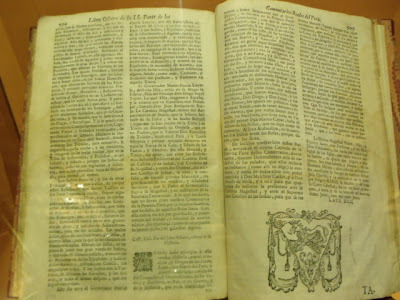
I got some nice books there, but I am most pleased with a facsimile edition of Garcilazo de la Vega's 1609 treatise, Primera Parte de los Comentarios Reales, que tratan del origen de los Yncas, reyes que fueron del Peru, de su idolatria, leyes, y govierno en paz y en guerra: de sus vidas y conquistas, y de todo lo que fue aquel Imperio y su Republica, antes que los Españoles passaran a el.  That book, known in English as the Royal Commentaries, was a landmark history and description of Inca Peru as it was the first written by a descendant of the subject of the book - Garcilazo was descendant of Inca emperor Tupac Yupanqui.   Lima's Universidad del Pacifico decided to mark it's 40th year of publishing by printing the full-size facsimile edition of the book.

An original copy of the Comentarios Reales displayed in Garcilazo's childhood home in Cusco

On the way home Liz and I mused about the success of the book fair, which draws people in droves, day after day over almost two weeks, and hat makes such an event possible here, as contrasted to the USA where book fairs are smaller and shorter events, with far fewer publishers represented.

Arequipa

On the 27th Liz and I, and my cousins and some of my nieces, traveled to the southern city of Arequipa. We stayed there until the morning of the 31st, and while there took in the sights and took an overnight trip to the Colca Valley, currently regarded as containing the world's deepest canyon.


We've now got just over a week left here and so are getting rather busy wrapping up loose ends before we head back to the US.