Thursday, July 18, 2013

Lima Art Museum & José Sabogal exhibit

Yesterday afternoon I headed toward downtown, to the Lima Museum of Art (Museo de Arte de Lima, MALI).

The MALI is located at one end of the Parque de la Exposición, at the intersection of Paseo Colón and Ave. Garcilazo de la Vega (everybody still calls it Wilson, its former name), about a block down from the former US Embassy and the Casa Matusita.

The "Byzantine Pavillion".  In the background, at right, the "Moorish Pavillion".

The Parque de la Exposición was built for the 1872 Lima International Exposition, and the MALI occupies the main building, the former Palacio de la Exposición (Exposition Palace).

t
The former Palacio de la Exposición, today the MALI

Interior atrium of the Palacio de la Exposición
The building itself was restored in the late 1950s to house the museum, which opened its doors to the public in 1961.


Installation in the foyer of the MALI

The MALI houses examples of 3000 years worth of Peruvian and other artistic creations.  It also offers art classes and courses in art history, and has a library that is open to the public.

My purpose for going, however, was to view the current exhibit of works by Peruvian indigenist painter José Sabogal.


Part of the Sabogal exhibit

Sabogal was one of the first, if not the first, artist of note to directly and explicitly incorporate Andean and indigenous imagery and persons as central subjects in art.  


At L, "Varayoc de Chinchero" (1925); at R, "Mujer del varayoc" (1926).


Sabogal thus played a key role in Peruvian art and in Peruvian social history, at a time when the idea of Peruvian nationhood was being redefined as result of the disastrous war with Chile, immigration, and other pressures.   There was a search for an "essential Peruvianness", based less on geographical accident than on culture and history. 


That gave rise to a broad indigenista movement, which sought to bring to the fore Peru's indigenous culture.  In politics, it led to movements to promote civil rights and integration of Peru's Indian majority, and the exhaltation of Peru's Inca past.  In literature and art it led to investigation of traditional arts and legends, the exploration of native Andean themes.  (Pretty much the same thing was going in Mexico, for example, which gave birth to that country's famed muralist school of art.)


"El gamonal"

Sabogal made a study of traditional pyrography and etchings on dried gourds, an traditional craft that is practiced throughout the country, and published several articles on the subject, and was inspired by it in his own etchings and other designs.

He played a foundational role in the development of Peru's indigenistas.  For example -and this was a revelation to me- it was Sabogal who suggested the name of Amauta, the seminal political and literay magazine founded by José Carlos Mariátegui, and it was Sabogal who developed its logos and interior artwork, as well as a number of the cover designs. 


Issue of Amauta with cover by Sabogal, in my library

Sabogal influenced a generation of Peruvian painters who could be called the indigenista school. Camilo Blas (1903-1985), just to give one example.

Last year I attended the opening of a show of paintings and drawings by Camilo Blas , who was the grandfather of my friend Carla, and was a friend and disciple of Sabogal's.  Blas' work made an impression, and from the MALI showing the influence that Sabogal had on Blas's work was clear.  In fact, my initial interest in the Sabogal show was that I confused Sabogal's work with Blas' when reading an article in a magazine about the opening of the exhibit!


Portrait of José Sabogal

Monday, July 15, 2013

Lunch in Pachacámac, at La Casa de Don Cucho


Yesterday Diego, Jacho, and I had  been feeling the need to get out of the city for a bit, so we slept in on Sunday -after two consecutive nights of staying up into the predawn hours (Friday just because, and Saturday at a birthday celebration)- and then headed out of Lima toward Pachácamac.

Pachacámac is the site of an Inca temple complex that once housed an oracle revered since pre-Inca times.   There is also a small town nearby, also called Pachacámac, which is a quiet little place.


Community chess lessons in downtown Pachacámac

Pachacámac does have some agriculture, but its main attraction for outsiders are the restaurantes campestres -"country restaurants"- on the outskirts of town.  These are establishments that specialize in serving foods that generally can't be cooked at home, such as spit-roasted meats, and foods cooked over wood fires, served outdoors.  They often include games and playgrounds for the kids to encourage families to stay a while.

We found our way to La Casa de Don Cucho, the establishment owned and run by restauranteur and TV cooking personality Luis "Cucho" La Rosa.

Cucho La Rosa

The restaurant occupies the grounds of the main house of the former Casa Blanca hacienda, and is filled with antiques and knicknacks that La Rosa or the previous owners gathered over the years.


One very notable feature is the sizable collection of old batanes distributed throughout the grounds.


A batán is a grinding stone, composed of a flat -well, actually slightly concave- mortar and a wide, basically bean-shaped pestle, that is used with both hands, in a rocking motion, to grind foods. 


They are an ancient tool, and still very much in use throughout Peru.  In fact, many people who have access to modern electric kitchen aids still prefer the textures and flavours of sauces produced on a batán.


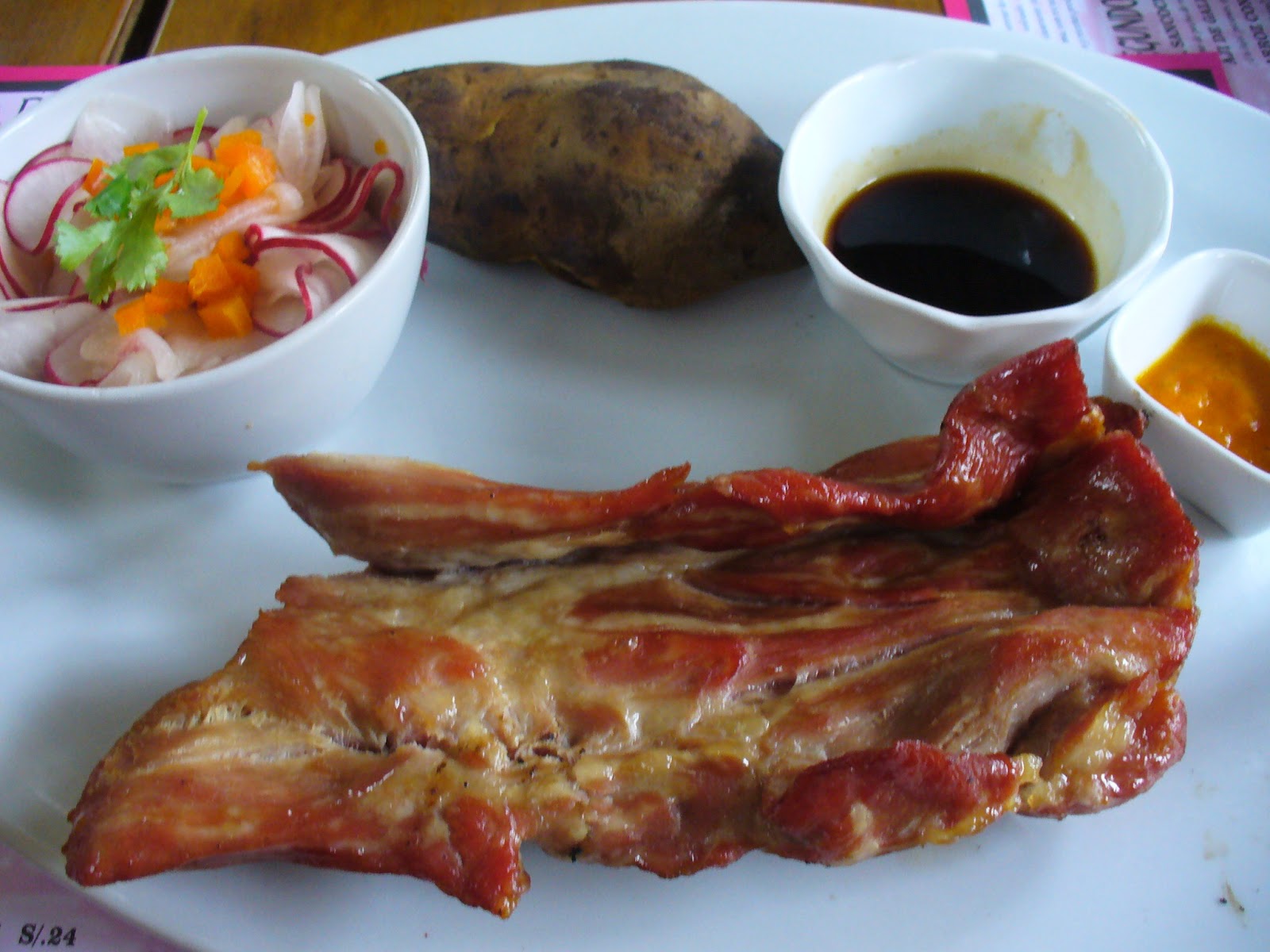
One food style that has come into fashion in recent years is meats cooked al cilindro.  Basically, it is meat that is suspended inside a steel drum that has been converted into an oven/smoker, with embers being placed in the bottom.


As I hand't yet tried any dishes cooked in this fashion, we naturally decided that that the pork al cilindro was one the dishes we had to order.


We began our meal with a shared plate of anticuchos -seasoned, grilled skewers of beef heart.

Anticuchos
Chupe de camarones
And, being in the watershed of the Lurín river, which is known for the quality of its crayfish, we opted for accompanying those with a shared bowl of crayfish stew - chupe de camarones.

Chancho al cilindro
We followed up by sharing the chancho al cilindro, and some arroz con pato - cilantro-laced rice and duck.


And we finished with a dessert of two puddings: purple corn-based mazamorra morada, and arroz con leche sweet rice pudding


La Casa de Don Cucho is a vast place, easily seating over a hundred tables at one time.  However, it is run with industrial effiency, and the service is prompt, courteous, and -most amazingly- accurate.  They seem able to get dozens and dozens of still-hot dishes out to diners spread throughout ten or eleven covered dining "rooms" with hardly any errors or delays.

We very much enjoyed our time there, as well as the food, which is well prepared, and comes in very generous portions -prefect for sharing.  In fact, we are planning on recruiting the rest of the family for a return outing next weekend.


Sunday, July 14, 2013

The Ministry of Education Building

This is the new Ministry of Education building, inaugurated in 2011.

The old building, in downtown Lima, was -at 22 stories- for a long time the tallest building in the country until it was overtaken in 1974 by the Centro Civico.  I always had an attachment to the building as my dad worked there for a while, and because its facade is covered at street level with green ceramic tiles manufactured by an granduncle of mine.

The new building -located in San Borja- is cleverly designed to look like a stack of books, and I must say, it is one of Lima's more distinctive modern office towers.


Friday, July 12, 2013

Slight earthquake today ...

A bit long, but not very jarring.  A 4-pointer, centered off the coast, about 30 miles SE of Lima.

If we hadn't been on the 15th floor we might not even have noticed it.

Thursday, July 11, 2013

The Cross of Plaza Elguera (once the Plazuela de La Salud)


In a recent post I talked about Jiron Quilca, and mentioned that at the intersection of Quilca and Av. Garcilazo de la Vega there used to be an Inca way station, or tambo.

In time that tambo gave way to a house of healing run by a religious order, and the spot became known as the Plazuela de La Salud (Plaza of Health).  Today it is the Plaza Elguera.

In one corner of said plaza there is a cross affixed to the wall of a building.  No inscription accompanies it and it could easily pass unnoticed.  However, it is not a mere decoration.

In 1884, during the Chilean occupation of Lima resulting from the War of  the Pacific, two Chilean soldiers were attacked in that vicinity.  The Chilean military governor ordered a search and five men were arrested.  After questioning some of them were released, but a couple were kept.  Unable to assign assign responsibility to each, as they would not cooperate, the commander drew lots and put one of the Peruvians up against a long adobe wall that then ran along that spot, whereupon the man was executed by firing squad as a lesson to the populace.

The spot of the execution became a symbol of patriotic resistance and not long afterward a wooden cross was placed upon it.   Decades later, when the modern buildings of downtown Lima were going up, the building company respected tradition and marked the spot with the cross we see today.

Jiron Quilca

This afternoon I headed back downtown, again to Jiron Quilca.


Quilca is a street that stands out in several ways.   One that is not very obvious from the ground -although it could become evident with a bit of thought- is that it does not conform to the grid pattern of downtown Lima, but rather comes off of Plaza San Martin at an agle.

In the photo below, Jiron Quilca can be appreciated in the foreground, approaching the plaza at an angle rather at odds with the regularity of the surrounding streets.

Photo: skyscrapercity.com

When Francisco Pizarro traced the layout for dowtown Lima, he followed the "damero" (checkerboard) pattern of manzanas (city blocks) separated by streets criss-crossing at right angles.  This pattern is repeated throughout Spanish America and is the reason that the core of downtown is sometimes referred to as the Damero de Pizarro.   Quilca, however, notably breaks that pattern, appearing almost as a gash in the city in the image above.

The story is that Quilca follows the path of an Inca road into the city, and that at the triangular plaza at the what is today the intersection of Quilca and Av. Garcilazo de la Vega (aka Av. Wilson) there was once a tambo, or Inca way station.

Quilca is also noted as a center of Lima's bohemian life.   For one thing, the stretch immediately contiguous to Plaza San Martin is lined with dive restaurants that come alive with at nightfall and spend the days sleepily puttering along, smelling of stale beer.

Quilca is, more meritoriously, also home to the Queirolo tavern, which was established in 1920 by relatives of the Queirolo wine and pisco-making family that owns the Santiago Queirolo distillery and Antigua Taberna Queirolo in Pueblo Libre.


The Queirolo, with its unchanged decor, is counted as one of Lima's classic bars and old-school eateries, and it fills up at lunch and in the evenings.

Quilca is also a locus of a more modern, youthful bohemian crowd, which tends toward the metal and punk "underground" scene.  Much of which is centered -spiritually, if no longer physically- on the El Averno cultural center.


The center, which housed gigs and promoted the arts in general, was a vibrant presence in Lima's "alternative" scene for more than a decade, but also a constant object of police interest, who regarded it as a locus of "delinquency", and as attracting "bad elements" and "pot smokers" (OK, so maybe that last one was true! LOL).  But, maybe even more than that, it was the fear instilled in institutional and bureaucratic conservatism by what is new, free, and transgressive.

The center was raided it on a number of occasions, with the cops -and on two occasions, hired thugs- tearing the doors out of their frames, looting the place, and sometimes violently attacking the young people they found inside. 


El Averno shut its doors for perhaps the last time last October, after losing an appeal against a municipal eviction order, but its building remains, vibrantly and wonderfully defiant.

And even though El Averno is closed, Quilca's punk and metal scene has hardly faded away, as tucked away among the many used bookstores that line the street, there are small shops selling CDs, DVDs, fanzines, and anarchist newspapers, and which serve as clearinghouses -as do the very walls of Quilca's buildings- of information on concerts and new releases.